Bottom Line Up Front
- Aggressive Airspace Probing: Russian UAV incursions into NATO airspace are accelerating; Romania intercepted or tracked 25 unauthorized drones in 2026 alone, bypassing the 18 total incursions recorded between 2022 and 2025.
- Expanded Launch Infrastructure: Open-source intelligence confirms Russia has expanded 10 western military bases, installing 59 new launch rails (20 optimized for long-range strikes) with localized storage capacities of up to 1,000 UAVs per site.
- Platform Modernization: Russia is fielding the jet-powered Geran-5 kamikaze drone, capable of a 950 km operational range at a cruising speed of 600 km/h with a 90 kg kinetic payload.
- Missile Overproduction: Russian military-industrial output is exceeding wartime targets, currently yielding 140% of Kh-101 and 200% of Kh-35 cruise missile quotas, alongside an estimated 1,300 ballistic missiles annually.
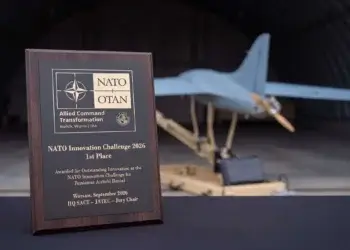
- NATO Counter-Investment: The Alliance has authorized a $40 billion Counter-Unmanned Aircraft Systems (C-UAS) initiative spanning five years, aiming to quintuple the number of certified drone operators by late 2027.
Strategic Context: Russian Aerial Aggression and Border Incursions
NATO leadership acknowledges that the Kremlin is systematically probing the Alliance’s eastern flank. In late 2025, NATO Secretary General Mark Rutte indicated that Moscow was conducting hybrid operations and preparing for a larger theater war before 2030. These provocations involve localized sabotage, cyber warfare, and highly calculated airspace violations.
The most alarming metric of this escalation is the spike in cross-border drone flights. NATO member Romania reported 25 drone incursions in 2026 by late August, a sharp increase from the 18 total violations tracked from 2022 through 2025. Allied airspace over Poland, Lithuania, Latvia, and Moldova has also been repeatedly breached, forcing NATO to transition its Baltic Air Policing mission into a localized air defense protocol.
Technical Platform Breakdown: The Jet-Powered Geran-5 Threat
Recent satellite imagery confirms a dramatic buildup in Russia’s stand-off strike capabilities along its western borders. Analysts have identified 10 expanded military installations featuring 59 new launch rails, with at least 20 explicitly reconfigured for long-range attack platforms. Forward-deployed bases now possess enough physical infrastructure to stockpile up to 1,000 UAVs per site, positioning them within striking distance of the Baltics and Poland.
Spearheading this offensive architecture is the Geran-5, a jet-powered iteration of the Iranian-designed Shahed series. The platform boasts a maximum operational range of 950 km (590 miles) and a peak velocity of 600 km/h (372 mph), heavily compressing NATO radar detection and interception windows. Armed with a 90 kg (200 lb) high-explosive fragmentation payload, swarm deployments of the Geran-5 are designed to saturate legacy air defense systems.
Complementing this UAV doctrine is an overperforming domestic missile sector. Recent intelligence assessments show Russian factories churning out 140% of Kh-101 cruise missiles, 200% of Kh-35s, and 111% of Kalibr-class munitions against stated targets. With an output of up to 1,300 ballistic missiles per year, Russia’s strategy relies on initiating any Baltic conflict with overwhelming, multi-domain precision strikes to shatter NATO’s forward defenses.
Operational Impact: NATO’s Three-Stage Land Warfighting Concept
To counter this massed firepower, NATO has formulated a highly modernized defense doctrine. Developed under the guidance of U.S. Army Major Andrew Pingray, the three-stage Land Warfighting Concept is designed to absorb, paralyze, and repel a Russian incursion.
Stage 1: SEAD/DEAD and Preemptive Suppression
NATO’s immediate tactical priority is the destruction of Russian long-range missile and air-defense networks. Planners recognize that any ground assault will be covered by localized anti-access/area denial (A2/AD) bubbles. Allied airpower and precision fires will explicitly target S-300, S-400, and Buk-M1 batteries, heavily prioritizing the heavily fortified Kaliningrad exclave.
Stage 2: The Autonomous Buffer Zone
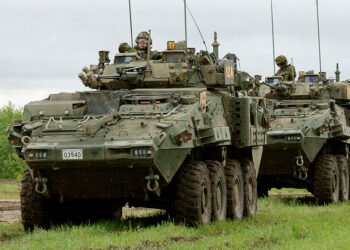
To mitigate NATO troop casualties in the opening hours of a conflict, the strategy introduces a fully automated defensive barrier along the Russian and Belarusian borders. Powered by the EFDI data backbone—described by U.S. Major Ben Schiff as the military’s “digital nervous system”—this zone will deploy AI-driven UAVs and unmanned ground vehicles (UGVs) to independently track, classify, and halt advancing Russian armor.
Stage 3: Deep Disruption and the Air Bridge
The final pillar shifts from defense to localized disruption inside Russian territory. NATO Special Operations Forces, working alongside internal Russian resistance networks, are tasked with crippling military logistics at the source. The doctrine also includes establishing an “air bridge” to infiltrate explosive drones deep behind enemy lines, targeting rail hubs, defense manufacturing plants, and forward aviation airfields.
Geopolitical Outlook: The Closing Window for Escalation
Vladimir Putin’s regime is facing severe domestic economic strain and mounting internal friction, creating a volatile strategic window. At 73, the Russian President may view a confrontation with NATO as a fleeting opportunity to solidify his legacy before structural decay and Western modernization outpace his military. Moscow’s threshold for escalation is also lowering, with the Kremlin recently threatening military action against the UK following the use of British munitions on Russian soil.
Time currently favors the Alliance. NATO’s $40 billion investment in Counter-UAS capabilities over the next five years will fundamentally harden Eastern Europe against drone saturation tactics. By 2027, NATO will graduate five times the current number of specialized drone operators. If Russia delays an offensive, it will face an impenetrable autonomous perimeter; if it acts now, it risks catastrophic attritional losses against a fully awakened Alliance.
| System / Asset | Classification | Key Specifications & Output | NATO Counter-Capability (2026-2027) |
| Geran-5 UAV | Jet-Powered Loitering Munition | Speed: 600 km/h Range: 950 km Payload: 90 kg | NATO EFDI Data Backbone (AI targeting); F-16 Combat Air Patrols |
| Kh-101 / Kh-35 | Air/Sea-Launched Cruise Missiles | Production: 140% – 200% above targets Yield: 400-450 kg conventional | Distributed Patriot PAC-3 & SAMP/T batteries; Autonomous Border Sensors |
| S-400 Triumf | Mobile SAM System (Kaliningrad) | Range: 400 km Simultaneous Targets: 36 | Stage 1 SEAD/DEAD; F-35 Lightning II stealth penetration |
| UAV Launch Bases | Fixed Infrastructure (Western Russia) | Sites: 10 expanded Rails: 59 total (20 long-range) | Stage 3 SOF Sabotage; “Air Bridge” drone infiltrations |
FINAL ASSESSMENT
Russia’s rapid expansion of drone launch infrastructure and missile production represents a severe, immediate threat to the Baltics. However, NATO’s shift away from legacy attrition warfare toward the Land Warfighting Concept serves as a definitive force multiplier. By offloading initial border friction to autonomous UGV/UAV swarms integrated via the EFDI backbone, NATO effectively neutralizes Russia’s numerical advantage in armor and massed infantry. The structural vulnerability now lies entirely with Russian logistics lines, which are poorly insulated against NATO’s Stage 3 deep-strike sabotage mandates.