Frontline Defense Journal | Objective OSINT & Military Analysis
  • Home
  • Latest Intelligence
  • Domain Of Warfare
    • Naval & Maritime
    • Air & Aerospace
    • Ground Forces & Armor
    • Unmanned & Autonomous Systems
    • Strategic Weapons
  • Regions
    • USA & Americas
    • Europe
    • Middle East
    • Asia & Pacific
  • Defense Archives
  • About Us
    • Who We Are
    • Privacy Policy
    • Terms Of Use
No Result
View All Result
  • Home
  • Latest Intelligence
  • Domain Of Warfare
    • Naval & Maritime
    • Air & Aerospace
    • Ground Forces & Armor
    • Unmanned & Autonomous Systems
    • Strategic Weapons
  • Regions
    • USA & Americas
    • Europe
    • Middle East
    • Asia & Pacific
  • Defense Archives
  • About Us
    • Who We Are
    • Privacy Policy
    • Terms Of Use
Frontline Defense Journal | Objective OSINT & Military Analysis
No Result
View All Result
Frontline Defense Journal | Objective OSINT & Military Analysis
No Result
View All Result
Home Defense Archives

King Tiger Technical Breakdown: Firepower, Armor, and Flaws

September 28, 2026
Reading Time: 8 mins read
A A
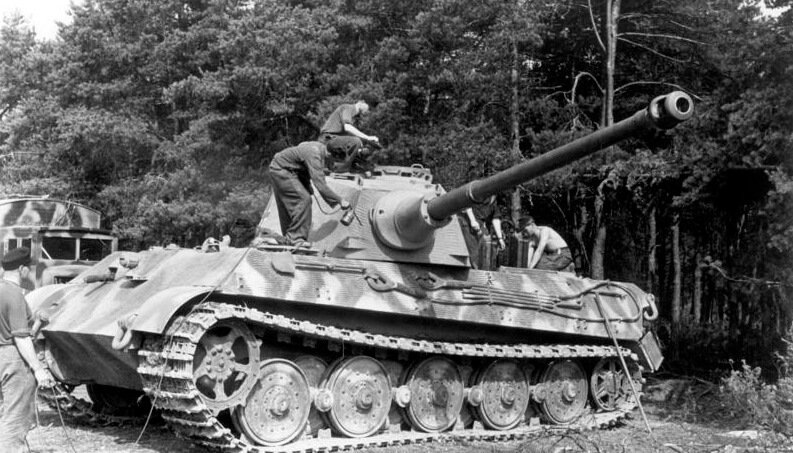
Panzerkampfwagen VI Ausf. B King Tiger tank with Henschel turret in a field.
Share on FacebookShare On Reddit

BOTTOM LINE UP FRONT

  • Unmatched Stand-off Firepower: The 88 mm KwK 43 L/71 gun achieved 100% test accuracy at 1,000 meters, firing armor-piercing rounds capable of penetrating 219 mm of plate at 500 meters.
  • Impenetrable Frontal Glacis: The 150 mm upper glacis plate, angled at 50 degrees (213 mm effective thickness), recorded zero documented combat penetrations.
  • Severe Drivetrain Mismatch: Reusing the transmission and final drives from the 10-ton lighter Tiger I caused final drive failures at an average interval of just 300 kilometers (186 miles).
  • Crippling Maintenance Overhead: Operational field data indicates the vehicle required 10 hours of maintenance for every 1 hour of operational movement.
  • Excessive Unit Cost: At 321,500 Reichsmarks per unit—double the cost of a Panther tank—the vehicle drained vital industrial resources during late-war supply shortages.

Ballistic Superiority: The 88 mm KwK 43 L/71

The main gun dominated engagements. Measuring 20.5 feet (6.2 meters) in length, the 88 mm KwK 43 L/71 provided high muzzle velocities between 1,968 ft/s (600 m/s) and 3,707 ft/s (1,130 m/s).

To manage recoil, engineers installed a double-baffle muzzle brake alongside a hydraulic recoil control cylinder and a hydropneumatic recuperator cylinder. Fume extraction was achieved by blowing compressed air through the barrel post-firing.
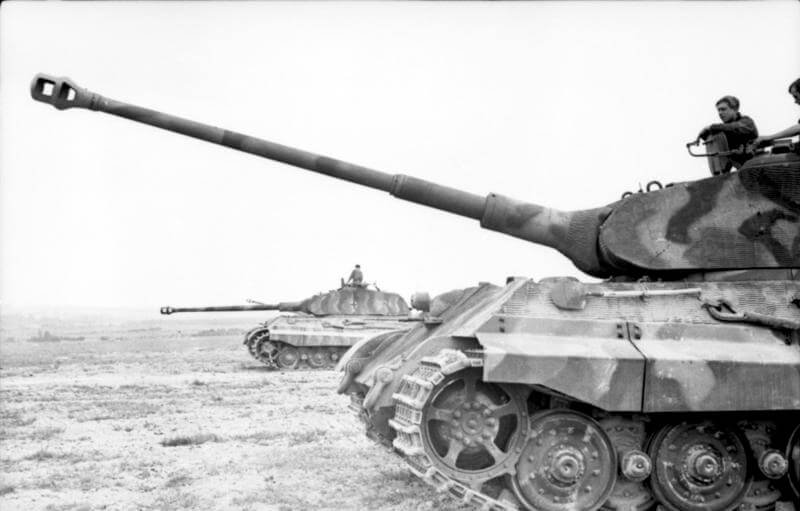
Panzerkampfwagen VI Ausf. B King Tiger tank with Henschel turret in a field.
The King Tiger’s 88 mm KwK 43 L/71 main gun extended overall vehicle length to 33 feet 9 inches. Image by: Bundesarchiv

The primary anti-armor munition was the Panzergranate 39/43 armor-piercing capped ballistic cap (APBC) round. Exiting the muzzle at 3,340 ft/s (1,018 m/s), the shell used a soft-metal armor-piercing cap to prevent ricochets on impact, penetrating 8.6 inches (219 mm) of armor at 500 meters before detonating an internal Amatol charge.

For heavier targets, crews carried the Panzergranate 40/43 tungsten-core round, capable of penetrating 9.9 inches (251 mm) of armor at 500 meters. Tungsten shortages limited its issue.

Target acquisition relied on the T.Z.F. 9d monocular sight. Featuring 2.5x and 5x magnification levels, the sight used a milliradian reticle pattern. Guners used stadiametric range-finding triangles to calculate target distances rapidly.

Field reports from Oberstleutnant Alfred Rubbel noted that Soviet T-34 armor could be reliably destroyed at ranges up to 3,000 meters.

Turret Engineering and Structural Armor Protection

The Henschel turret housed the primary armament asymmetrically on a 72.8-inch (1,850 mm) turret ring. The asymmetry provided necessary working space for the gunner on the left side of the breech.

Turret armor measured 7.1 inches (180 mm) on the front plate at a 10-degree slope, protected by a 5.9-inch (150 mm) “Saukopf” cast gun mantlet. Turret sides and rear used 3.15-inch (80 mm) armor plates.

Turret traverse was driven hydraulically via a power take-off shaft connected to the main engine. At 2,000 engine rpm, a full 360-degree rotation took 19 seconds. At max 3,000 rpm, rotation speed dropped under 10 seconds, though high-speed operation increased mechanical failure rates.

Manual handwheels provided precision fine-aiming and emergency backup. The loader managed a 22-round ready rack in the turret rear, while 48 rounds were stowed along the hull walls.

The hull featured an upper glacis plate of 5.9 inches (150 mm) angled at 50 degrees, creating an effective horizontal thickness of 8.3 inches (213 mm). The lower glacis measured 3.9 inches (100 mm) at 50 degrees.

Secondary armament included a coaxial 7.92 mm MG-34 machine gun operated via foot pedal, and a hull-mounted MG-34 in a ball mount guided by the radio operator using an armored head-dome. A roof-mounted Nahverteidigungswaffe launcher fired smoke, flare, and anti-personnel fragmentation grenades.
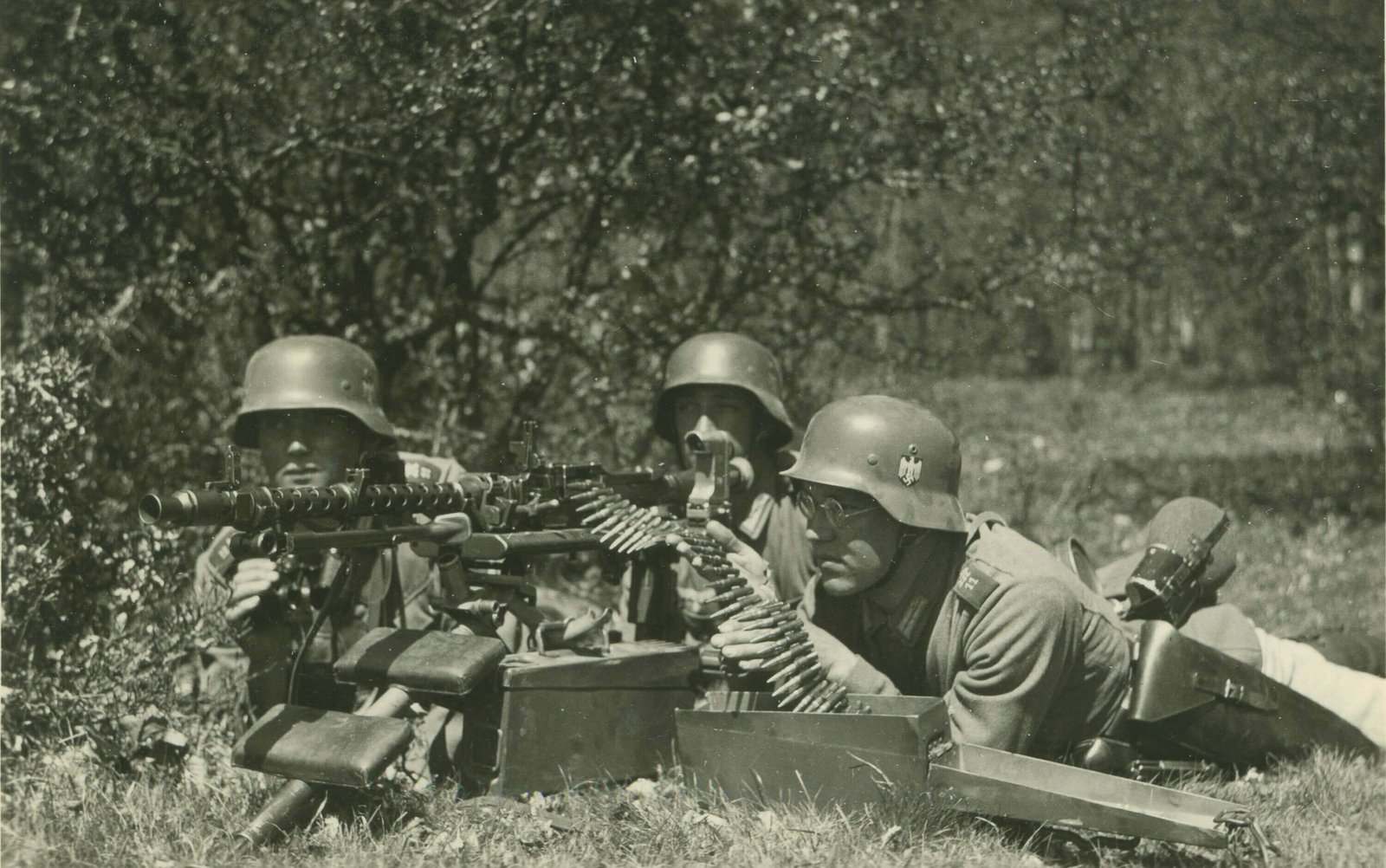
MG 34 mounted on a Lafette 34 tripod with MG Z 34 4× telescopic sight
The MG 34. Image by: Losse Fotografische Objecten

Propulsion Limits, Drivetrain Overstress, and Maintenance Collapse

Tactical mobility collapsed under the vehicle’s extreme mass. Power was supplied by a 23-liter V-12 Maybach HL 230 P30 cast-iron gasoline engine delivering 700 horsepower at 3,000 rpm and 1,364.5 lb-ft of torque at 2,100 rpm.

The engine used a specialized tunnel crankshaft with roller bearings. Seven internal fuel tanks held 227 gallons of gasoline. Fuel burn exceeded 2 gallons per mile, capping operational range at 105.6 miles on roads and 74.5 miles cross-country.
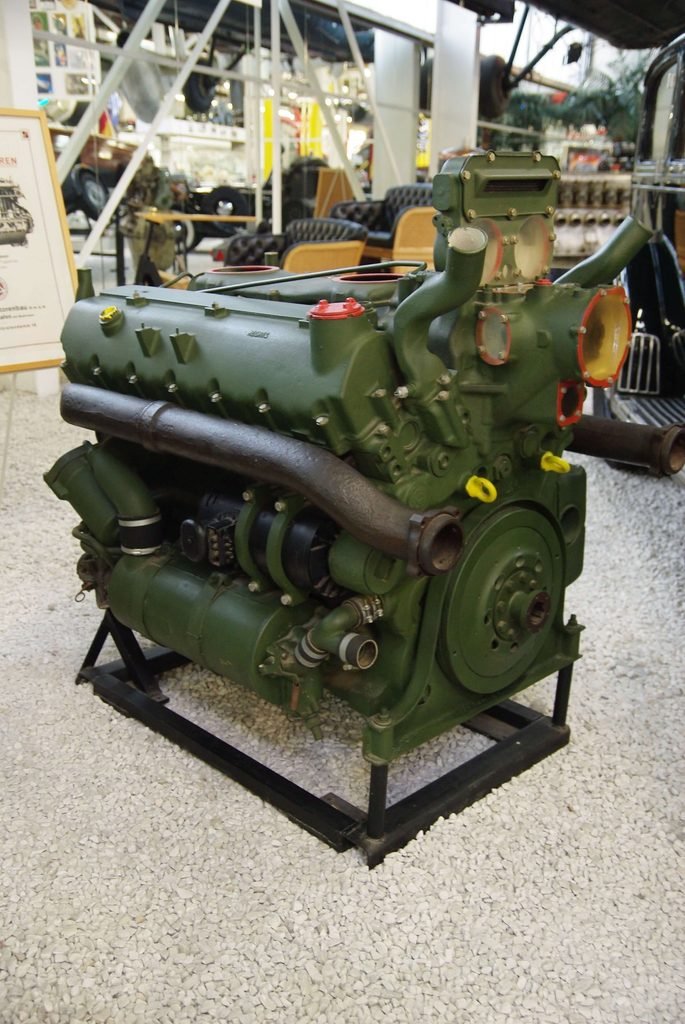
an image of King Tiger German Tank Engine. The 23-liter V-12 Maybach HL 230 P30 cast-iron gasoline engine delivering 700 horsepower at 3,000 rpm and 1,364.5 lb-ft of torque at 2,100 rpm.
The Maybach HL230 P30. Image by: Bilderling

The tank’s primary structural defect resided in the drivetrain. The cancellation of the Panther II forced engineers to reuse the Maybach Olvar OG 40 12 16b eight-speed transmission and final drives from the Tiger I.

These components were engineered for a vehicle weighing 10 tons less. Extreme torque sheared drive sprocket teeth and destroyed final drive planetary gears.

Final drive units had an average lifespan of just 186 miles (300 kilometers). Mechanics serviced vehicles constantly; every 1 hour of operation required 10 hours of maintenance.

SS-Obersturmbannführer Joachim Peiper stated that three out of every five King Tigers lost in combat were abandoned and destroyed by their own crews due to mechanical breakdowns during retreat.

Specification / ParameterMetric ValueOperational Impact / Structural Limit
Combat Mass154,000 lbs (69.8 tons)Exceeded European bridge weight limits; restricted transport
Main Armament88 mm KwK 43 L/71Sustained high muzzle velocity (1,018 m/s APBC)
Upper Glacis Armor150 mm @ 50° (213 mm effective)Zero documented combat penetrations from frontal arc
Turret Front Armor180 mm @ 10° (182.8 mm effective)Heavy front-aspect protection against Allied main tank guns
Engine Output700 hp @ 3,000 rpmUnderpowered power-to-weight ratio (10.0 hp/ton)
Fuel Capacity / Range227 gal / 105.6 miles roadSevere logistical burden; high risk of fuel line leaks and fires
Final Drive MTBF186 miles (300 km)Component failure required vehicle abandonment during maneuvers
Unit Production Cost321,500 ReichsmarksTwice the cost of a Panther; unsustainable industrial strain
FINAL ASSESSMENT: The King Tiger was a tactical triumph and a strategic disaster. Its combination of the 88 mm KwK 43 L/71 gun and an impenetrable 150 mm sloped glacis made it nearly invulnerable in long-range defensive engagements. However, placing a 69.8-ton vehicle on a drivetrain built for a lighter tank created unacceptable mechanical fragility. Breakdowns outpaced enemy anti-tank fire. Drivetrain failure rates every 300 kilometers and a 10:1 maintenance-to-operational-hour ratio made the platform a severe logistical liability during operational movements.

Tags: Armored WarfareWorld War IIWWII Tanks

Related Posts

USAF The B-17F Flying Fortress
Defense Archives

B-17F Flying Fortress Technical Breakdown: Armor, Armament, and the Brutal Reality of Daylight Bombing

October 4, 2026
Cutaway diagram or close-up profile of a B-17 ball turret showing the fetal position of the gunner.
Defense Archives

B-17 Ball Turret Technical Breakdown: Firepower, Armor, and Survival

September 29, 2026
A U.S. Army M2A4 Bradley infantry fighting vehicle maneuvering during testing exercises.
Ground Forces & Armor

AI FireAnt Swarms Turn M2A4 Bradley Into UGV Mothership

September 15, 2026
Next Post
Cutaway diagram or close-up profile of a B-17 ball turret showing the fetal position of the gunner.

B-17 Ball Turret Technical Breakdown: Firepower, Armor, and Survival

Leave a Reply Cancel reply

Your email address will not be published. Required fields are marked *

I agree to the Terms & Conditions and Privacy Policy.

Latest Intelligence

Can Iran Reverse-engineering US Navy Anduril Dive LD Autonomous Submarine

US Navy Cancels Constellation Frigate: FFG-62 Procurement Disaster

B-17F Flying Fortress Technical Breakdown: Armor, Armament, and the Brutal Reality of Daylight Bombing

China’s GJ-11 Sharp Sword: The Stealth UCAV Rewriting Indo-Pacific SEAD Operations

US Navy Awards Boeing $20B F/A-XX Sixth-Gen Carrier Fighter Contract

LPP Wins NATO Challenge With AI Off-Grid Airfield Denial

Domain Of Warfare

M142 High Mobility Artillery Rocket System (HIMARS) fires a training rocket during a live-fire exercise in Undva, Estonia, July 11, 2025. The exercise included dry-firing, equipment staging, communication systems checks, and concluded with live-fire qualifications.
Naval & Maritime

US Army Expands HIMARS Role With PrSM Anti-Ship Strike

An air-to-air overhead front view of an SR-71A strategic reconnaissance aircraft. The SR-71 is unofficially known as the "Blackbird."
Air & Aerospace

NASA Moves SR-71 Blackbird: Flight Test or SR-72 Reveal?

Cutaway diagram or close-up profile of a B-17 ball turret showing the fetal position of the gunner.
Defense Archives

B-17 Ball Turret Technical Breakdown: Firepower, Armor, and Survival

An air-to-air front view of a B-52G Stratofortress aircraft from the 416th bombardment Wing armed with AGM-86B air-launched cruise missiles (ALCMs).
Strategic Weapons

USAF Advances $30B AGM-181A LRSO Nuclear Cruise Missile

Defense Archives

B-17F Flying Fortress Technical Breakdown: Armor, Armament, and the Brutal Reality of Daylight Bombing

USAF The B-17F Flying Fortress

The Boeing B-17F Flying Fortress was the blunt-force instrument of the Allied daylight strategic bombing campaign over Europe. Tasked with...

Read moreDetails

B-17 Ball Turret Technical Breakdown: Firepower, Armor, and Survival

Cutaway diagram or close-up profile of a B-17 ball turret showing the fetal position of the gunner.

BOTTOM LINE UP FRONT Advanced Fire Control: The Sperry K-4 automatic computing gunsight calculated gravity, wind speed, aircraft velocity, and...

Read moreDetails

Surviving the Nuclear Battlefield: The Rise and Fall of the U.S. Army’s Pentomic Divisions

US Army launcher vehicle based on the M139D 5-ton truck. Honest John nuclear-capable rocket artillery.

“In the search for maximum dispersion on an atomic battlefield, the Pentomic division traded the proven flexibility of combined arms...

Read moreDetails

The Evolution of the British Army Infantry Section (WWI to 2026)

A member of British No. 9 Commando at Anzio equipped for a patrol with his Bren gun 5 March 1944.

BOTTOM LINE UP FRONT WWI & The All Arms Concept (1916-1918): Prompted by massive losses at the Somme, the British...

Read moreDetails

Frontline Defense is an independent, objective analysis platform. The content provided on this website, including but not limited to technical breakdowns, military hardware comparisons, defense budget reports, and open-source intelligence (OSINT) analyses, is strictly for educational, historical, and informational purposes. Frontline Defense is not affiliated with, endorsed by, or acting on behalf of any government agency, department of defense, armed forces branch, or defense contractor. All content on this site represents independent research based strictly on unclassified, publicly available data and open-source records at the time of writing. Nothing published on this website should be construed as official military guidance, defense strategy consulting, or government policy.

Follow Us

Domain Of Warfare

  • Naval & Maritime
  • Air & Aerospace
  • Ground Forces & Armor
  • Strategic Weapons
  • Unmanned & Autonomous Systems

Regions

  • USA & Americas
  • Europe
  • Middle East
  • Asia & Pacific
  • About Us
  • Privacy Policy
  • Terms Of Use

© 2026 | Fronline Defense Journal. All Rights Reserved

No Result
View All Result
  • Home
  • Latest Intelligence
  • Domain Of Warfare
    • Naval & Maritime
    • Air & Aerospace
    • Ground Forces & Armor
    • Unmanned & Autonomous Systems
    • Strategic Weapons
  • Regions
    • USA & Americas
    • Europe
    • Middle East
    • Asia & Pacific
  • Defense Archives
  • About Us
    • Who We Are
    • Privacy Policy
    • Terms Of Use

© 2026 | Fronline Defense Journal. All Rights Reserved