BOTTOM LINE UP FRONT
- Advanced Fire Control: The Sperry K-4 automatic computing gunsight calculated gravity, wind speed, aircraft velocity, and turret rotation to generate automatic firing solutions, removing the need for manual range estimation.
- Independent Oxygen Supply: To prevent oxygen hoses from rupturing during 360-degree turret rotations, the gunner relied on an independent, externally mounted oxygen bottle providing a strict two-hour supply.
- Contrary to the Vulnerability Myth: Despite its exposed position, 8th Air Force wound ratios indicated ball turret gunners suffered only 6% of crew wounds, heavily shielded by the turret’s steel seating, equipment layout, and dual machine guns.
- Extreme Production Cost: A single ball turret cost $14,300 in 1944 (approximately $250,000 today), with the Sperry K-4 gunsight alone accounting for 25% of that price tag.
Structural Engineering and Integration
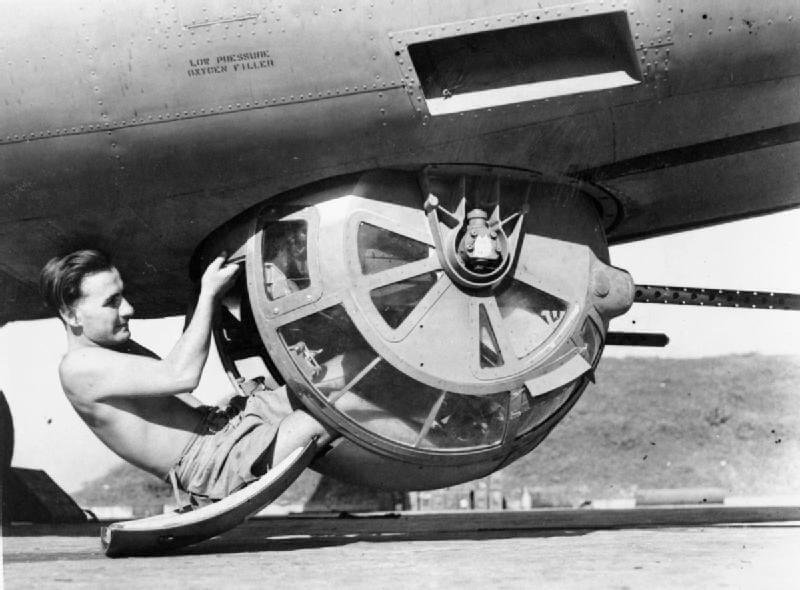
The A-2 turret was a highly compact, aerodynamic sphere measuring just 44 inches in diameter and weighing 850 pounds. It sat suspended within a 46.5-inch hole in the B-17’s lower fuselage via a trunnion ring and a supporting harness.
This harness not only provided structural rigidity but acted as a conduit for the aircraft’s electrical power. To solve the problem of severed wires during continuous rotation, engineers utilized a system of rotating brush connectors within a swivel bracket at the top of the harness.
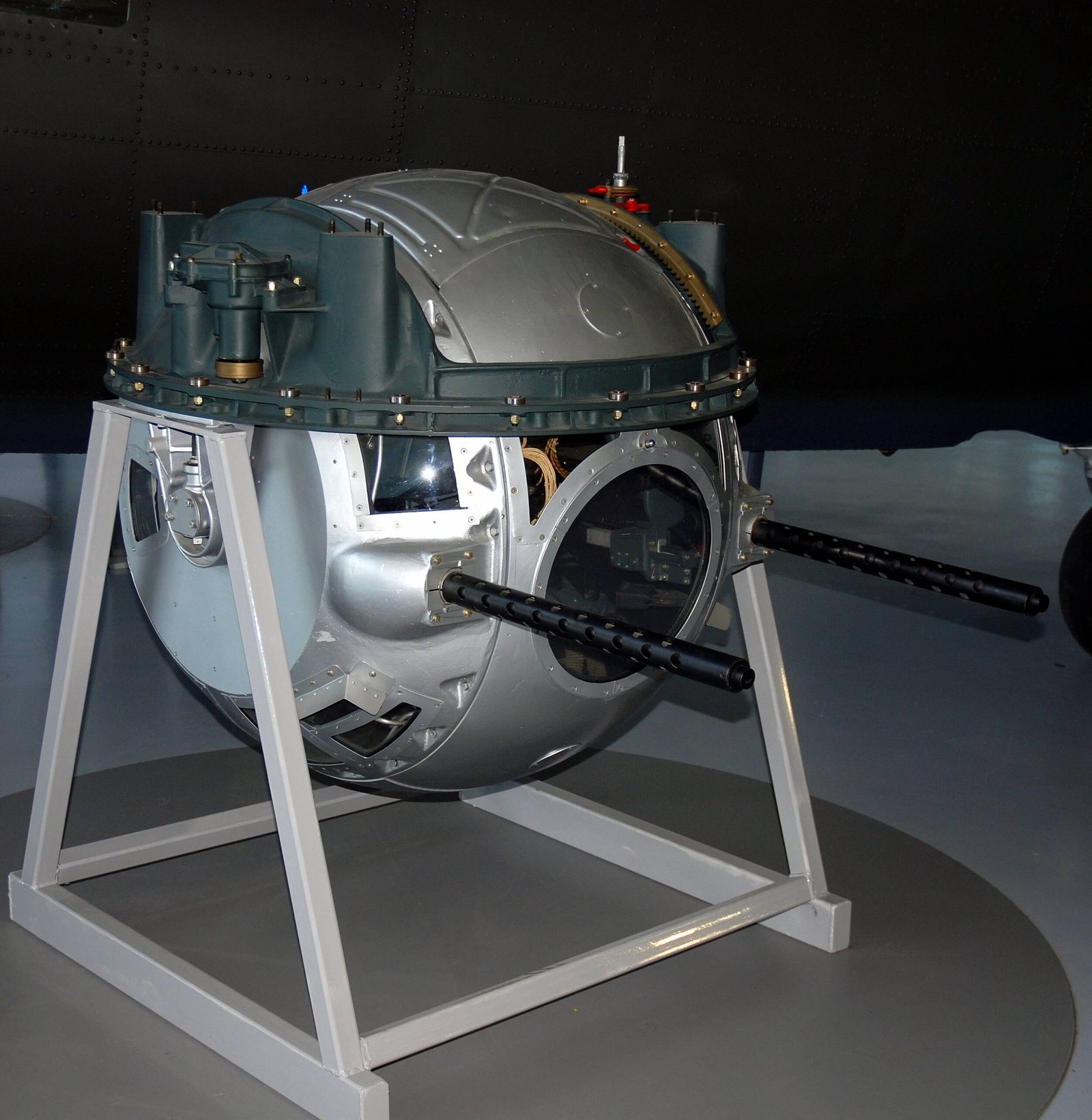
Because the turret could not retract into the B-17’s fuselage, the 36-inch protruding gun barrels posed a severe ground-strike hazard. Before takeoff and landing, the turret had to be hand-cranked to its maximum 85-degree vertical elevation, locking the barrels almost flush with the aircraft’s underbelly.
The Gunner’s Operating Environment
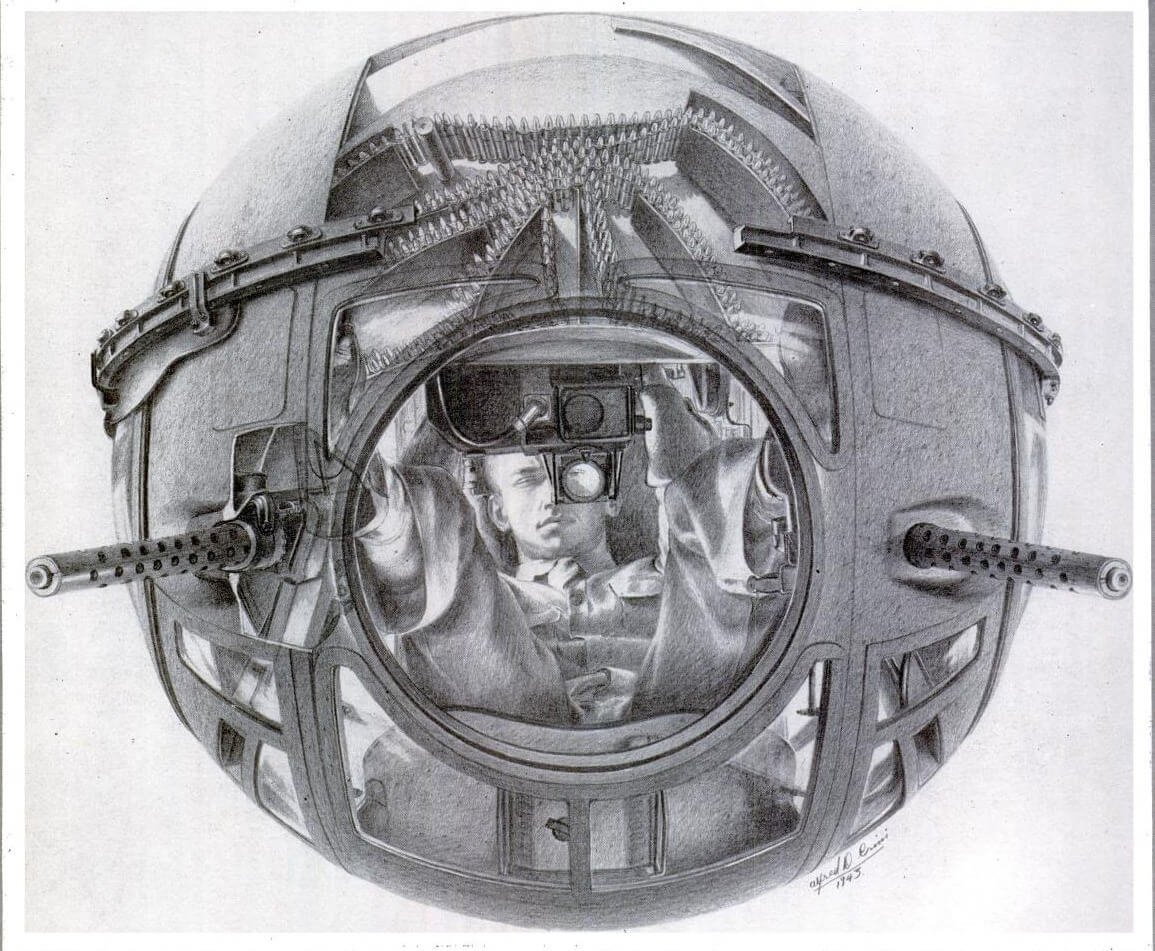
Gunners entered the turret mid-flight at altitudes between 9,000 and 10,000 feet, just before crossing into enemy airspace and requiring oxygen. The operator assumed a strict fetal position: knees drawn to the chest, back resting against the cast aluminum entry hatch and 0.26-inch steel bottom, and feet locked into rests flanking the main sighting window.
The A-2 was neither pressurized nor insulated. Internal temperatures routinely plummeted to -50°F. Bare skin would instantly freeze to the interior metal, necessitating heavy leather flying suits, fur-lined boots, thick gloves, and an electrically heated under-suit.
Space was so restricted that the gunner could not wear a parachute; they wore only the harness, with the parachute pack stowed above in the radio operator’s compartment. If the aircraft sustained fatal damage, the gunner had to align the turret, exit into the fuselage, clip on their parachute, and bail out. In an emergency wheels-up crash landing, a 20-minute jettison procedure required the crew to remove 12 connecting nuts and smash four safety hooks to drop the 850-pound unit from the airframe.
Firepower and the Sperry K-4 Computer
The A-2 was armed with twin M2 .50 caliber machine guns, delivering a combined cyclic rate of 750 rounds per minute. The turret housed its own ammunition payload: 445 rounds in the right bin and 571 rounds in the left bin.
Because of the extreme spatial constraints, gunners lacked the physical leverage to manually pull the charging handles on the heavy machine guns. Engineers solved this by installing a cross-arm cable and pulley system near the footrests, allowing the gunner to rack the bolts using their body weight.
The core of the turret’s lethality was the Sperry K-4 automatic computing gunsight. Hanging just above the gunner’s eyeline, the K-4 was a marvel of mechanical computation. The gunner framed the enemy fighter using a zoom pedal on the left footrest. By keeping the target continuously framed, the mechanical computer automatically calculated lead trajectories based on target speed, B-17 airspeed, gravity, and the turret’s rotation rate.
Turret movement was dictated by a central hand control unit. Powered electrically, the A-2 could complete a full 360-degree rotation in 8 seconds and elevate 90 degrees in 3 seconds. A mechanical forward-facing cam automatically cut the firing solenoids if the guns swept across the B-17’s own propellers, though it did not protect open bomb bay doors.
Armor and Survivability
Despite the visual exposure of hanging beneath the bomber, the ball turret was heavily fortified. The gunner essentially sat in an armored cradle.
The primary backrest consisted of a 0.6-inch steel seat plate and a 0.26-inch curved steel bottom, rated to stop .30 caliber rounds and deflect flak shrapnel. The main forward sighting window utilized double-thickness, tempered laminated glass.
Crucially, the interior equipment layout acted as composite armor. The gunner’s legs were shielded by the dual .50 caliber receivers and ammunition bins, while the bulky K-4 gunsight provided upper torso protection against rounds striking from above. Post-war statistics from the 95th Bomb Group confirmed that the ball turret position was statistically on par with the tail gunner for survivability, entirely dispelling the myth of the ball turret as a guaranteed death sentence.
| Parameter | Metric | Tactical Implication |
| Turret Diameter | 44 inches | Extreme spatial constraints; parachute worn externally |
| Total Weight | 850 lbs | Required heavy structural harness and trunnion ring |
| Armament | 2x M2 .50 Caliber | High stopping power; 750 RPM cyclic rate |
| Ammunition Capacity | 1,016 Rounds | 445 (Right) / 571 (Left); self-contained inside turret |
| Traverse Speed | 360° in 8 seconds | Rapid target acquisition for fast-moving fighter intercepts |
| Primary Armor | 0.6-inch steel seat | Reliable deflection of .30 caliber fire and standard flak |
| Unit Production Cost | $14,300 (1944) | High resource drain; K-4 sight was 25% of total cost |