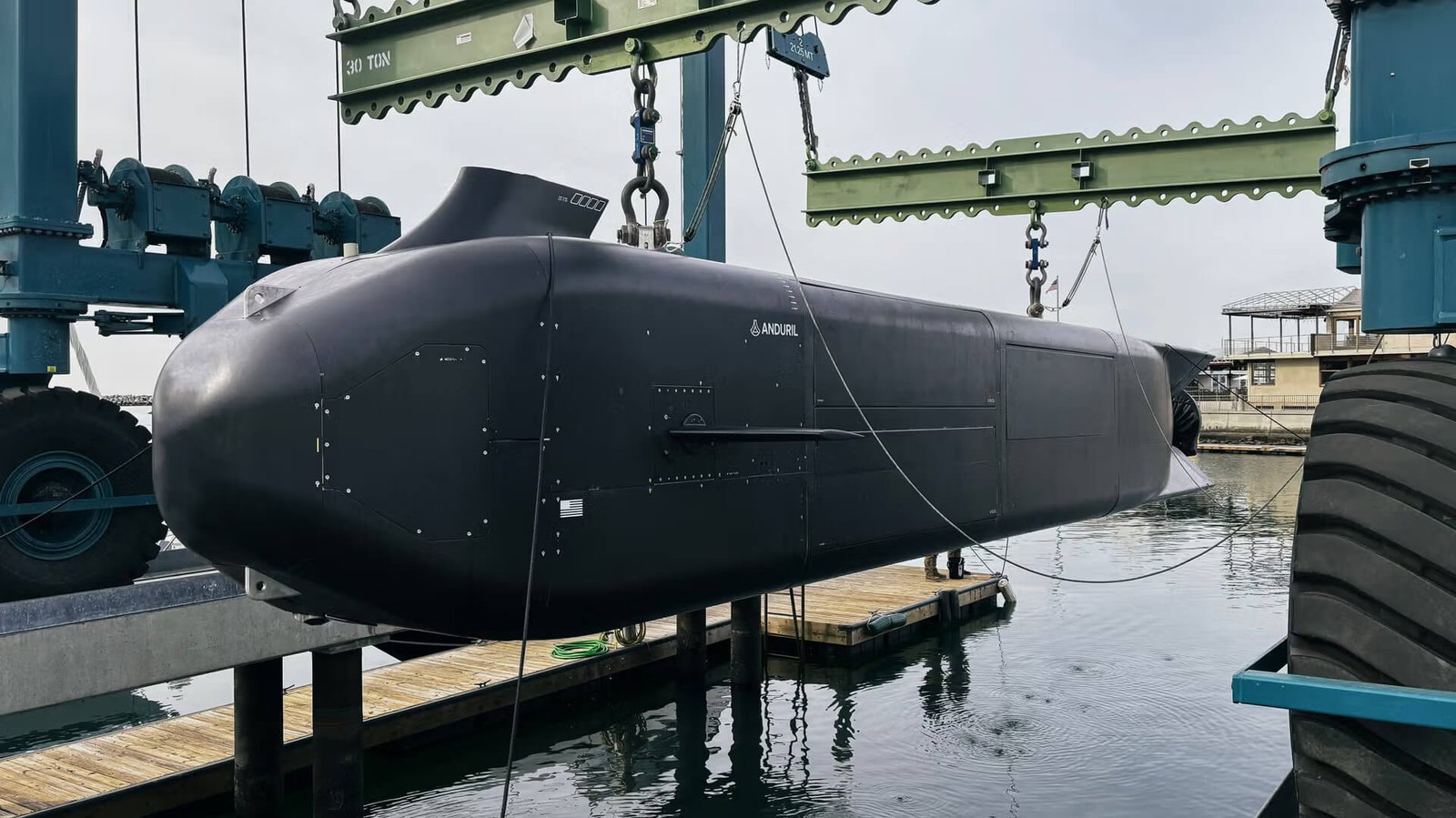
Iranian naval forces recovered a malfunctioning U.S. autonomous underwater vehicle in the Gulf of Oman on September 8, 2026. The platform, an Anduril Dive LD, was executing a regional survey mission before losing communication. U.S. Central Command confirmed the loss and stated the vehicle carried no classified sensors. The seizure grants Tehran physical access to American commercial-off-the-shelf undersea manufacturing techniques and modular payload architectures.
- Asset Loss: Iranian state media broadcasted the physical recovery of a 2.7-ton U.S. unmanned system from open waters.
- Platform Origin: The Dive LD is manufactured by Anduril, following the defense contractor’s 2022 acquisition of Dive Technologies.
- Financial Scope: The U.S. Navy committed $94.4 million to the acquisition program by May 2025. Unit cost is estimated at $2.5 million.
- Technology Compromise: The captured vehicle features large-format 3D-printed fairings, a free-flooded aluminum frame, and pressure-tolerant 93 kWh Kraken lithium batteries.
- Production Scale: Anduril’s Rhode Island facility targets an annual production capacity exceeding 200 vehicles to support initiatives like Replicator.
Platform Architecture and Technical Specifications
The Dive LD utilizes a free-flooded hull design. Seawater fills the spaces between the 3D-printed outer fairings and the internal aluminum A-frame during descent. This eliminates the requirement for a heavy, full-body pressure vessel. Sensitive electronics and payloads are housed in localized pressure modules.
The vehicle measures 5.8 meters in length and 1.2 meters in diameter. It displaces 2.7 tons. Syntactic foam containing microscopic hollow glass spheres provides buoyancy, allowing operations at a maximum depth rating of 6,000 meters.
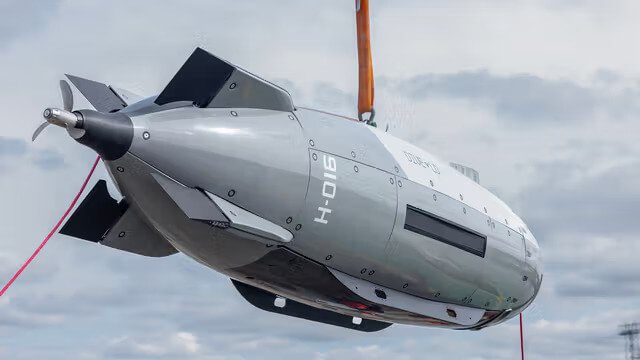
Power is supplied by scalable, pressure-tolerant lithium batteries yielding up to 93 kWh. A single rear thruster provides propulsion. Four tail surfaces arranged in an X-configuration steer the vehicle. Emergency drop weights allow the platform to shed ballast and surface during critical failures.
Navigation, Payloads, and Communications Constraints
Submerged navigation relies on an internal inertial navigation system. A Doppler velocity log and depth sensors correct accumulated track errors. The vehicle communicates underwater via low-bandwidth acoustic signals. Surface communication relies on an Iridium satellite link for status reports.
The payload bay offers over 1 cubic meter of internal capacity. Mission configurations include side-scan sonar, synthetic aperture sonar, multi-beam echo sounders, and sub-bottom profilers.
The system processes sonar data internally utilizing Anduril’s Lattice software. The onboard processing allows the vehicle to detect seabed anomalies and autonomously alter its route for closer inspection without waiting for surface operator commands.
Procurement, Scaling, and the Replicator Initiative
The U.S. Navy accelerated the acquisition of the Dive LD following the cancellation of the Snakehead program and repeated delays to Boeing’s Orca extra-large unmanned submarine. The Defense Innovation Unit initiated a commercial prototype competition for large underwater vehicles in July 2023.
Sailors began operating the platform at Keyport, Washington, in late 2024. The government allocated $94.4 million for the program through May 2025.
To meet procurement demands, Anduril opened a 150,000-square-foot production facility in Rhode Island in August 2025. The plant is designed to manufacture over 200 vehicles annually. The platform is reportedly selected for the Pentagon‘s Replicator initiative, which aims to field autonomous systems rapidly across multiple domains.
Geopolitical Fallout and Technology Transfer Risks
The September 8 seizure occurred after the drone experienced a mechanical or software malfunction. U.S. recovery assets failed to reach the drift site before Iranian naval units. U.S. Central Command stated the vehicle carried no classified radar or sonar.
Physical possession grants Iranian defense engineers direct insight into the platform’s assembly. State technicians can analyze the 3D-printed composite structures, battery housings, and modular integration methods.
Reverse-engineering the proprietary Lattice software remains a significant hurdle without access to Anduril’s broader network. However, the intact physical hardware provides a foundational baseline for domestic Iranian unmanned underwater vehicle development.
| Specification | Anduril Dive LD Metric | Operational Notes |
| Length | 5.8 meters (19 ft) | Modular sections allow scalability. |
| Diameter | 1.2 meters (4 ft) | Free-flooded external fairing design. |
| Weight | 2.7 tons | Requires dedicated surface vessel crane for recovery. |
| Max Depth | 6,000 meters | Buoyancy maintained via syntactic foam. |
| Endurance | Up to 10 days | Dependent on payload power draw and battery configuration. |
| Power Plant | 93 kWh Lithium | Scalable, pressure-tolerant Kraken battery modules. |
| Payload Capacity | >1 cubic meter | Supports side-scan sonar, magnetic sensors, and mine warfare modules. |
| Estimated Unit Cost | $2.5 million | Commercial-off-the-shelf components keep costs below traditional naval platforms. |
FINAL ASSESSMENT: The loss of a Dive LD demonstrates the primary operational risk of attritable autonomous systems. The platform successfully removed human crews from high-risk forward deployment zones, fulfilling its primary design objective. However, the lack of onboard scuttling mechanisms presents a structural vulnerability for hardware compromise. The strategic trade-off is definitive: rapid procurement and cost savings via commercial architectures directly increase the risk of physical technology proliferation when uncrewed systems fail in contested waters.