KEY INTELLIGENCE
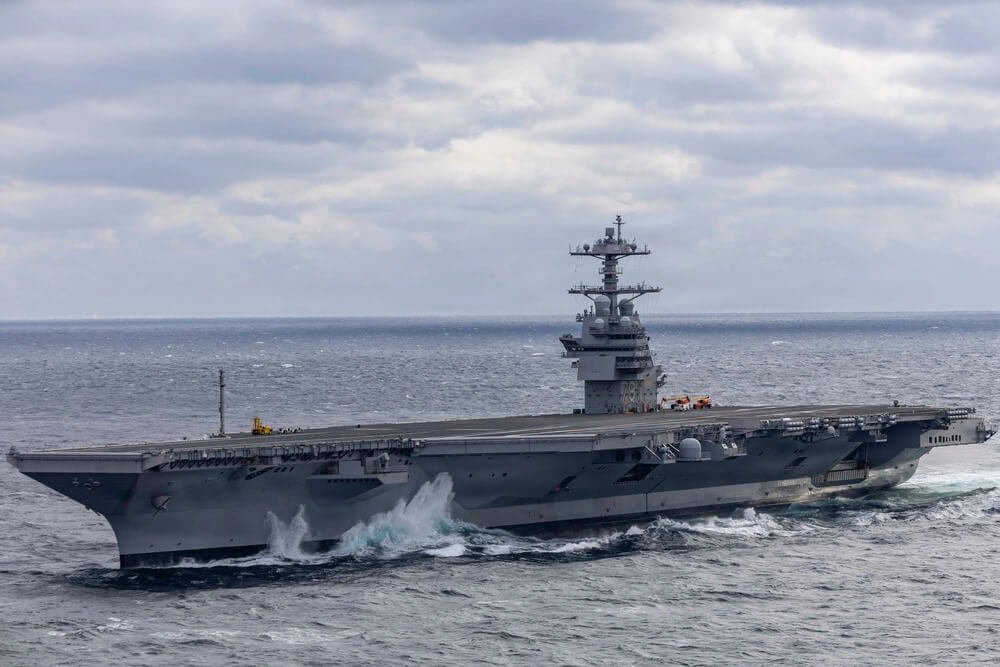
- Procurement Shift: Single-phase delivery mandate ensures CVN-79 deploys fully F-35C capable, avoiding the multi-year retrofit cycle that crippled the USS Gerald R. Ford.
- Cost & Sensor Optimization: The heavily delayed $484M Dual-Band Radar (DBR) was deleted from the design. It is replaced by the AN/SPY-6(V)3 and AN/SPQ-9B, saving $180M and aligning logistics with the surface fleet.
- Kinetic Output: Two Bechtel A1B reactors triple electrical generation to a 13,800V grid, powering EMALS and Advanced Arresting Gear (AAG) for a projected 160–270 daily sortie generation rate.
- Force Structure Impact: Delivery delays to March 2027 required a $95.7M life-extension contract for the 51-year-old USS Nimitz to prevent U.S. carrier force levels from dropping below the congressional 11-ship minimum.
The 11-Carrier Mandate and Nimitz Extension
Federal law requires the U.S. Navy to maintain 11 operational aircraft carriers to sustain global deployment, training, and maintenance rotations. The Kennedy’s delivery timeline—pushed from July 2025 to March 2027 to certify its 11 Advanced Weapons Elevators and arresting gear—directly threatened this statutory baseline.
To prevent a critical gap in maritime force projection, the Navy issued a $95.7 million extension to keep the 51-year-old USS Nimitz (CVN-68) active until March 2027. This decision ties the retirement of the fleet’s oldest vessel precisely to the handover of its newest, demonstrating the severe logistical fragility within the current carrier strike group rotation.
Redesigning the Ford-Class Baseline
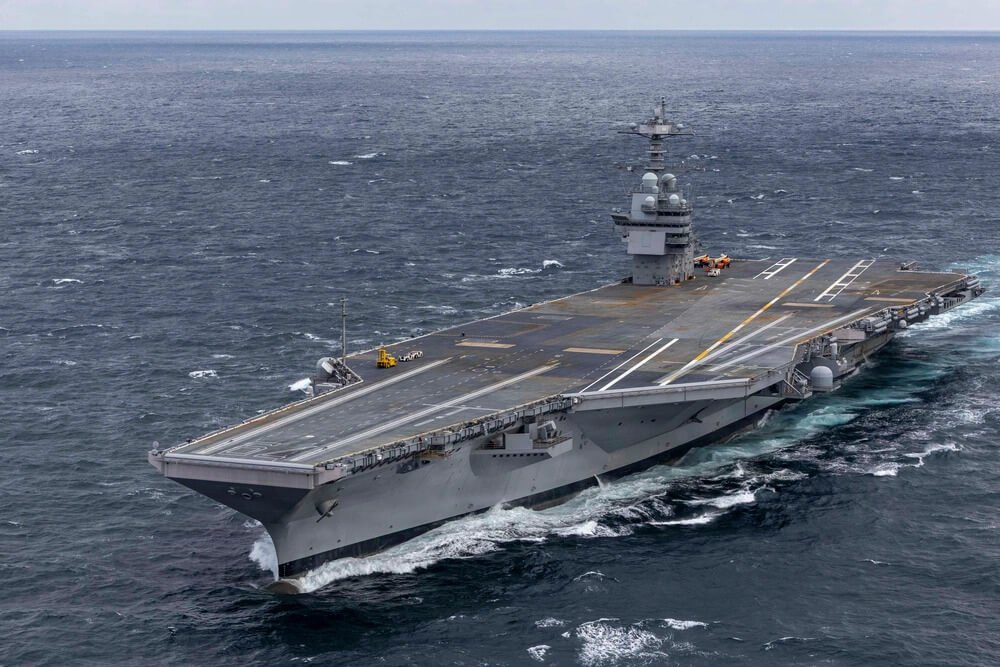
Displacing 100,000 long tons and measuring 1,106 feet, CVN-79 is structurally distinct from legacy platforms. The Navy reduced the ship’s company to 2,600 sailors—roughly 600 fewer than a Nimitz-class. This reduction reallocates internal volume for armor, power routing, and defense systems, transferring the burden of damage control heavily onto automated electrical architecture.
A1B Reactors, EMALS, and Sortie Generation
The carrier’s lethality is entirely dependent on its electrical grid. Two Bechtel A1B nuclear reactors deliver a 13,800V architecture—tripling the electrical output of legacy carriers. This massive power generation replaces traditional steam catapults with the Electromagnetic Aircraft Launch System (EMALS).
The system relies on four spinning disc alternators holding 120 megajoules each (nearly 500 megajoules total). This linear induction motor can launch a 50-ton fighter to 130 knots in seconds, recharging in just 45 seconds. Paired with the software-controlled Advanced Arresting Gear (AAG), this architecture is designed to surge from a baseline of 160 up to 270 aircraft launches per day.
The $180M Sensor Overhaul
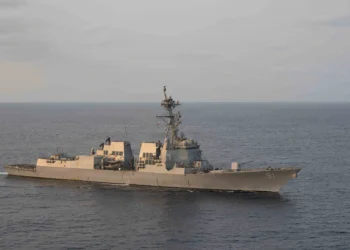
The most significant modification to CVN-79 is the removal of the proprietary Dual-Band Radar (DBR), which bloated to $484 million on the Ford. Kennedy instead integrates three flat-panel AN/SPY-6(V)3 Enterprise Surveillance Radars into its island superstructure, paired with the legacy AN/SPQ-9B. This pivot not only saved the Navy $180 million but unified the carrier’s sensor supply chain with the Arleigh Burke-class Flight III destroyers and Constellation-class frigates.
Geopolitical Outlook: Pacific Pivot
Assuming CVN-79 clears its Navy Acceptance Trials in late 2026, the vessel is slated to be the first Ford-class carrier deployed to the Indo-Pacific. With the subsequent carrier, the future USS Enterprise (CVN-80), already delayed to July 2030, the Kennedy must achieve immediate operational readiness. There is no strategic buffer left to absorb further shipyard delays without compromising U.S. deterrence posture against peer adversaries in the Pacific.
Fleet Comparison: Nimitz-Class vs. CVN-79 (Ford-Class Variant)
| Technical Specification | USS Nimitz (CVN-68) Baseline | USS John F. Kennedy (CVN-79) | Tactical Advantage / Impact |
| Power Generation | 2x A4W Reactors (4,160V Grid) | 2x A1B Reactors (13,800V Grid) | 300% increase in electrical capacity; eliminates reliance on steam/hydraulics. |
| Launch / Recovery | Steam Catapults / Hydraulic Gear | EMALS / Advanced Arresting Gear (AAG) | Dialable launch/catch tension extends airframe life; capable of launching lightweight drones to heavy F-35Cs. |
| Primary Radar System | AN/SPS-48 / AN/SPS-49 | AN/SPY-6(V)3 / AN/SPQ-9B | Seamless data-sharing with escort destroyers; massive cost reduction vs. DBR. |
| Max Sortie Rate | ~120 Launches per day | 160 – 270 Launches per day | 33% baseline increase in kinetic force projection capability. |
| Ship’s Company | ~3,200 Sailors | ~2,600 Sailors | Reduced lifecycle personnel costs; transfers survivability burden to automated systems. |
CVN-79 represents a harsh, necessary course correction in U.S. naval procurement. By mandating single-phase delivery for F-35C integration and aggressively deleting the bloated DBR system, the Navy prioritized lethal combat readiness over shipyard scheduling optics. However, the $11.4 billion platform relies entirely on unproven automated damage control and a highly reduced crew to sustain high-tempo combat operations. Its performance during the upcoming 2026 Navy Acceptance Trials—and its subsequent Indo-Pacific deployment—will conclusively dictate whether the Ford-class architecture can reliably project dominant airpower, or if its electrical complexity will remain a systemic vulnerability.