
Bottom Line Up Front
- Marathon Endurance: The carrier spent 286 days deployed in active combat zones, operating 4 months past its original scheduled return date.
- High-Intensity Air Ops: CVW-9 (Carrier Air Wing 9) executed over 10,000 combat sorties while the strike group defended against persistent Iranian proxy munitions.
- Disinformation Vector: Chinese state-affiliated social media accounts and internet commentators have circulated photos of the carrier’s rust to push narratives of U.S. naval decay. By contrast, the longest recorded at-sea deployment for a Chinese aircraft carrier is roughly 40 days.
- Maintenance Realities: The U.S. Navy spends approximately $6 billion annually combating corrosion. Eradicating running rust requires extensive needle-gunning, toxic material mitigation, and multi-layer coating applications—procedures that are structurally impossible to perform while launching high-tempo combat sorties.
The Reality of a 286-Day Combat Optempo
When a 1,000-foot nuclear-powered warship spends over nine consecutive months in one of the world’s most corrosive environments, it will bear the physical scars of that endurance. The USS Abraham Lincoln was deployed to an incredibly tense and volatile theater, navigating a conflict characterized by persistent anti-ship ballistic missile (ASBM) threats and one-way attack drones.
Operating under these conditions exacts a massive toll on the crew. The deployment was extended by nearly four months past its original timeline, severely testing the endurance of the sailors and Marines on board who were forced to operate with degraded supply lines and no confirmed end date. The psychological and physical strain of sustaining a 10,000-sortie combat pace without standard rotational relief is the true story of this deployment—not the cosmetic state of the hull.
Running Rust vs. Online Disinformation
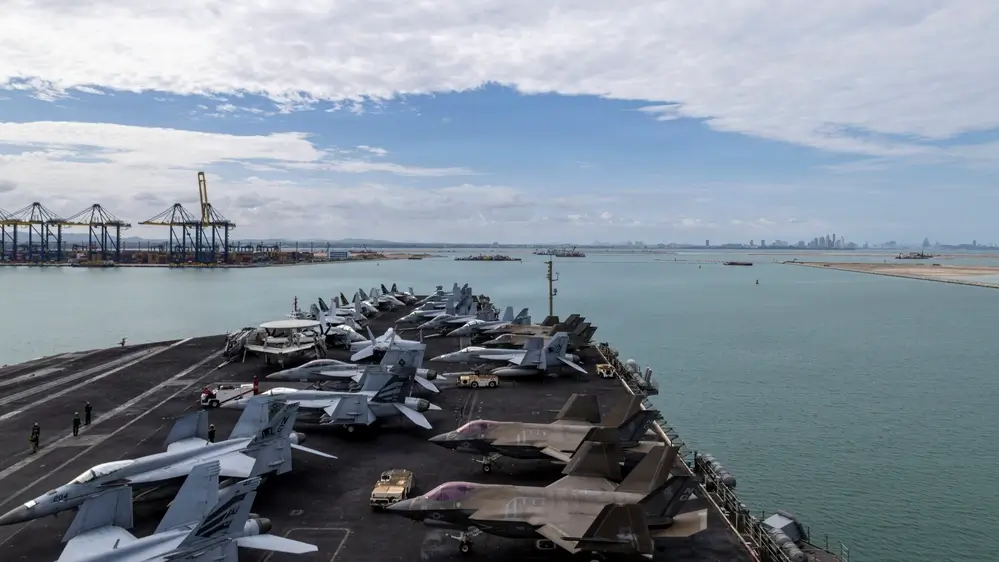
Immediately upon the Lincoln’s arrival in Thailand, images of the ship’s rust-streaked hull sparked a wave of internet hyperbole. Chinese social media accounts quickly weaponized the optics, framing the rust as proof of American military decline and naval incompetence.
This narrative relies on a fundamental misunderstanding of naval engineering and operational priorities. There is a critical difference between running rust (surface oxidation that bleeds down the hull when exposed to saltwater and oxygen) and structural corrosion (deep pitting that compromises the strength of the steel). While running rust looks terrible on camera, it does not impact the carrier’s combat effectiveness.
Furthermore, the geopolitical hypocrisy of these claims is stark. The People’s Liberation Army Navy (PLAN) celebrated a milestone earlier this year when one of its aircraft carriers managed just 40 days at sea. The Lincoln surpassed that milestone seven times over on a single deployment, while actively engaged in hostile fire.
The Mechanics of Naval Corrosion Control
Combating rust is a relentless, multi-billion-dollar effort for Naval Sea Systems Command (NAVSEA). Saltwater, humidity, and intense heat create an aggressive oxidative environment. Standard Navy procedure to address this involves a labor-intensive, multi-step process:
- Washing and degreasing the affected area.
- Mechanically removing the rust using pneumatic needle guns or grinders.
- Cleaning the bare metal again.
- Applying specialized primer coats.
- Applying the final protective topcoats.
On older Nimitz-class carriers like the Lincoln (commissioned in 1989), this process is further complicated by strict environmental and safety regulations, as older base coatings contain high levels of lead and toxic materials.
Expecting sailors to dangle from scaffolding over the side of the ship to needle-gun rust while simultaneously dodging Iranian drones and launching F-35Cs and F/A-18s is a fantasy pushed by individuals who have never spent a day at sea.
Carrier Operations: Reality vs. Disinformation Narratives
| Metric | USS Abraham Lincoln (Current Deployment) | PLAN (Chinese) Carriers (Record Deployment) | Strategic Context |
| Days at Sea | 286 Days | ~40 Days | U.S. forces sustain global power projection; PLAN remains limited to regional green/blue-water adjacent operations. |
| Combat Sorties | 10,000+ | 0 (Training Only) | U.S. carriers launch heavily armed strike packages in active threat rings; PLAN carriers focus on basic launch/recovery proficiency. |
| Threat Environment | Active hostile fire (ASBMs, UAVs) | Permissive (Peacetime) | U.S. crews operate under constant threat of kinetic interception; topside cosmetic maintenance is deprioritized for combat ops. |
| Logistics | 28 days continuous w/o shore resupply | Heavily shore-reliant | The ability to resupply underway via Military Sealift Command is a critical U.S. asymmetric advantage. |
Final Assessment
COSMETICS DO NOT DICTATE LETHALITY. The rust on the hull of the USS Abraham Lincoln is not a symptom of naval failure; it is the physical receipt for 286 days of holding the line in a hostile theater. While the optics may feed political talking points and foreign propaganda, the underlying reality is that the U.S. Navy successfully sustained a massive floating airbase in a combat zone for nine and a half months. The real strategic concern highlighted by this deployment is not corrosion control, but rather the severe strain placed on sailors and the carrier fleet’s overall capacity. Extending deployments by four months due to a lack of available replacement decks points to deeper industrial base and shipbuilding shortfalls—a far more pressing issue than peeling paint.