
Bottom Line Up Front
- The Atmospheric Bottleneck: The effective range of a laser is fundamentally limited by line-of-sight and the Earth’s atmosphere. At sea level, phenomena like atmospheric scattering (energy absorption by water droplets/salt) and thermal blooming (heat distorting the beam’s refractive index) cap effective ranges to roughly 2 to 10 miles.
- The Power Paradox: Increasing a laser’s kilowatt (kW) output does not linearly increase its range. In fact, pumping more power through the atmosphere can worsen thermal blooming, meaning a 150 kW laser can sometimes out-range a 1 MW weapon.
- Dwell Time vs. Velocity: To destroy a target, a laser must remain focused on a specific spot for 5 to 10 seconds (dwell time). Against ballistic or hypersonic missiles closing at miles per second, lasers simply do not have the range to engage early enough to burn through a nose cone before impact.
- Magazine Depth & Cost: What lasers lack in range, they make up for in magazine depth and cost-efficiency. Engagements cost between $1 and $10 per shot, limited only by the platform’s power generation capacity.
The Physics of Failure: Why Range is Hard-Capped
The first and most intuitive challenge facing long-range directed energy is line of sight. Unlike a surface-to-air missile that can intercept threats over the horizon, a laser cannot engage a surface-skimming cruise missile or drone boat until it physically broaches the horizon—which, for a shipborne system, might be as close as 5 to 15 miles depending on mast height.
However, the laws of physics degrade the beam long before it reaches even that horizon. Inside Earth’s atmosphere, lasers are not traveling through a vacuum. They push through uneven pockets of gases, vapor, and microscopic debris. Atmospheric scattering occurs when a laser hits water droplets (especially dense in maritime environments), bleeding off energy and scattering light away from the target path.
This lost energy creates a secondary, more complex problem: thermal blooming. As the laser bleeds heat into the surrounding air, it warms it. Because warm air is less dense, it changes the refractive index of the atmosphere, effectively acting as a distorted lens that bends or diffuses the beam. According to U.S. Naval Postgraduate School research, simply dialing up the power from 150 kW to 1 MW to force through these barriers often worsens thermal blooming, rapidly diminishing returns.
The Dwell Time Dilemma and Target Thresholds
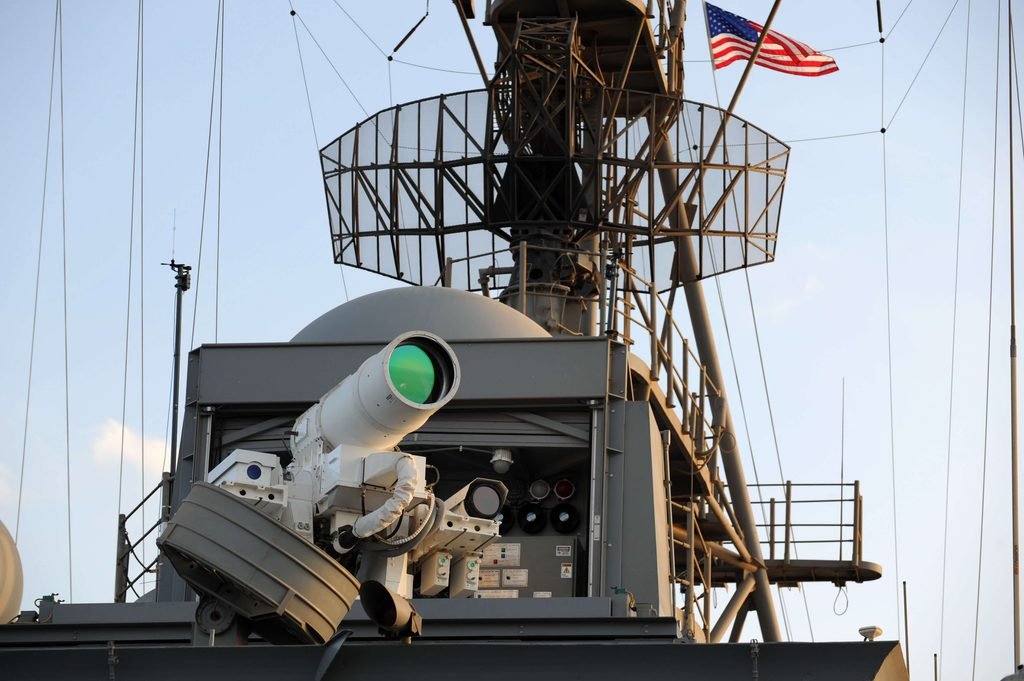
Because range is physically hard-capped at a handful of miles, a laser’s power output dictates what it can kill within that short window, rather than how far it can shoot. Lasers do not impart kinetic impact; they transfer heat. Neutralizing a threat requires holding the beam on a single point to melt through outer casings—a metric known as dwell time.
For example, a 60 kW class laser requires approximately 13 seconds of continuous dwell time to burn through 3mm of aircraft aluminum, and 20 seconds for titanium. This makes lower-tier systems highly effective against slow, unarmored quadcopters, but utterly useless against a hypersonic glide vehicle closing at Mach 5+. To scale up target viability, power output must scale dramatically.
The Modern Hierarchy of Laser Power
While international headlines frequently boast of new “miracle” laser defenses, analyzing their true power output reveals their strict tactical limitations. Development is heavily classified, but the known, unclassified systems fall into three distinct operational tiers.
Global Directed Energy Air Defense Systems
| Power Output Tier | Primary Capability | Key Operational / Prototype Systems |
| Sub-50 kW | Optics dazzling, Group 1/FPV drones (long dwell). | • US Army 20kW M-HEL • US Navy 30kW LaWS • China 30kW LW-30 • S. Korea 20kW Block-I |
| 50 kW – 100 kW | Small drones, rockets, mortars, artillery. | • Israel 100kW Iron Beam • Australia 100kW Apollo • UK 50kW DragonFire • US Navy 60kW HELIOS |
| 100 kW – 300 kW | Group 3 drones, burning sides of cruise missiles. | • US Navy/Army 150kW JLWS • US Army 300kW Valkyrie (IFPC-HEL) • Gen. Atomics/Boeing 300kW • China 300kW LY-1 |
| 400 kW – 1 MW+ | Nose-cones, rapid burn-through (Classified R&D). | • US Navy 400kW Songbo • Lockheed HELSI Phase 2 (500kW) • nLIGHT HELSI 2 (1 MW goal) |
STRATEGIC VERDICT
THE TACTICAL REALITY OF DIRECTED ENERGY. Lasers are not a silver bullet for the hypersonic missile threat, nor will they replace the long-range umbrella of kinetic interceptors like Patriot and THAAD. Their strict physics-based range limits guarantee they will always remain a short-range asset. However, their strategic value lies in point-defense magazine depth. By acting as a virtually limitless, dollar-a-shot CIWS to screen against high-volume, low-cost drone swarms and incoming mortars, multi-hundred-kilowatt lasers allow naval vessels and ground bases to reserve their highly capable, expensive kinetic interceptors for the high-end threats that truly warrant them. Air defense is about layered capability; lasers are merely the glowing inner layer of a much larger shield.