Frontline Defense Journal | Objective OSINT & Military Analysis
  • Home
  • Latest Intelligence
  • Domain Of Warfare
    • Naval & Maritime
    • Air & Aerospace
    • Ground Forces & Armor
    • Unmanned & Autonomous Systems
    • Strategic Weapons
  • Regions
    • USA & Americas
    • Europe
    • Middle East
    • Asia & Pacific
  • Defense Archives
  • About Us
    • Who We Are
    • Privacy Policy
    • Terms Of Use
No Result
View All Result
  • Home
  • Latest Intelligence
  • Domain Of Warfare
    • Naval & Maritime
    • Air & Aerospace
    • Ground Forces & Armor
    • Unmanned & Autonomous Systems
    • Strategic Weapons
  • Regions
    • USA & Americas
    • Europe
    • Middle East
    • Asia & Pacific
  • Defense Archives
  • About Us
    • Who We Are
    • Privacy Policy
    • Terms Of Use
Frontline Defense Journal | Objective OSINT & Military Analysis
No Result
View All Result
Frontline Defense Journal | Objective OSINT & Military Analysis
No Result
View All Result
Home Domain Of Warfare Air & Aerospace

ASC 890 AEW&C: Ukraine’s New Aerial Radar Blinds Russia

September 14, 2026
Reading Time: 6 mins read
A A
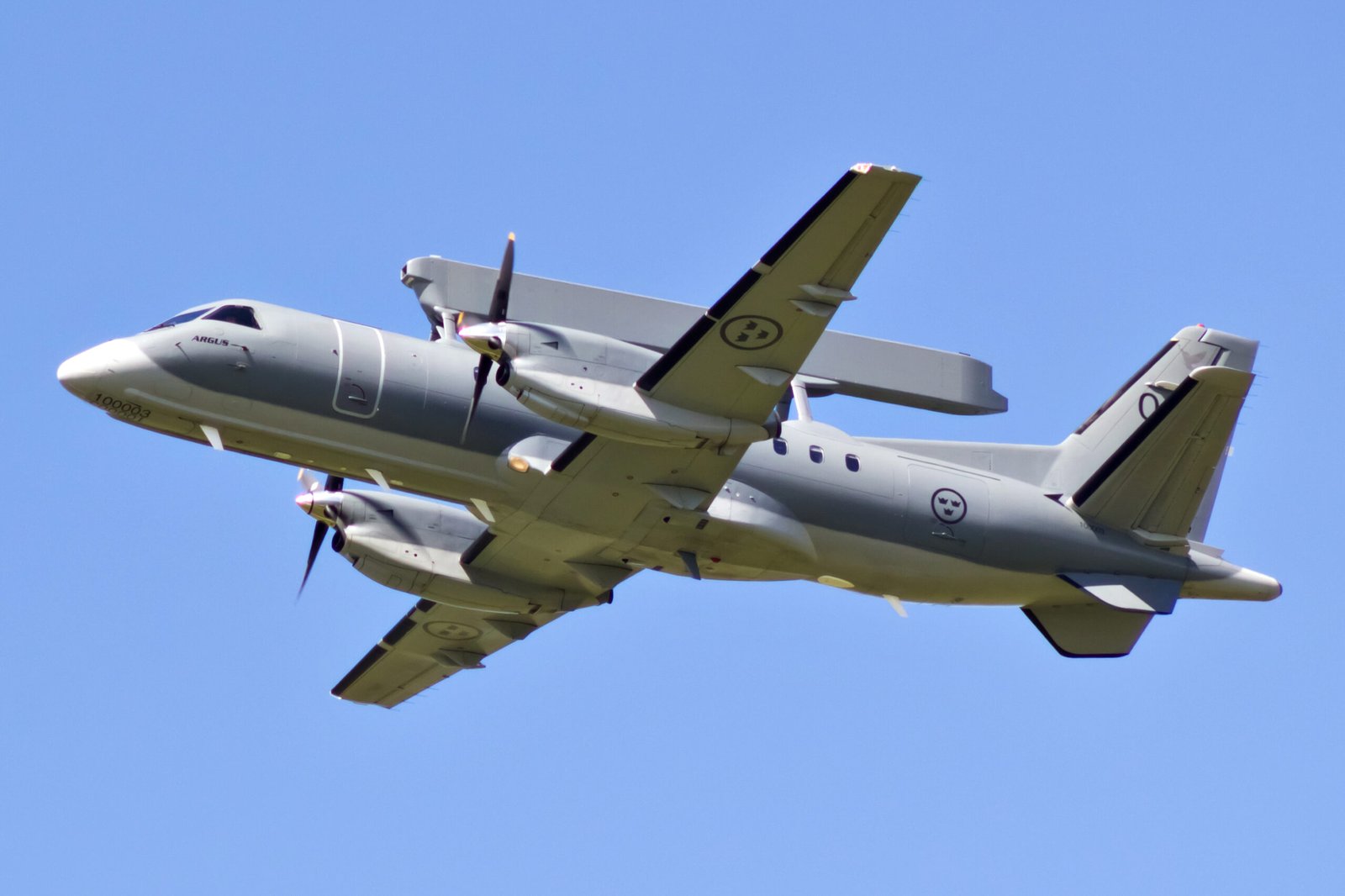
Saab 340 AEW&C (ASC 890) aircraft featuring the fixed rectangular Erieye AESA radar fairing on its fuselage.
Share on FacebookShare On Reddit

BOTTOM LINE UP FRONT

  • Platform Integration: The Saab 340 AEW&C (ASC 890) operates the PS-890 Erieye AESA radar, providing all-weather, S-band detection capabilities up to 400 km.
  • Operational Window: Officially confirmed by the Ministry of Defense, the aircraft has been actively flying combat missions over Ukraine for six months without Russian detection or interception.
  • Russian Attrition: Deployment capitalizes on Russia’s degraded AEW&C capabilities, following the destruction of two Beriev A-50s in early 2024 and damage to a third in Belarus.
  • Threat Matrix: The aircraft is actively tracking incoming barrages from Russia’s summer offensive, which saw 1,858 missiles launched between January and August 2026.
  • Air Defense Degradation: Russia’s inability to target the slow-moving, high-emission ASC 890 highlights structural vulnerabilities, compounding the loss of 1,609 Russian anti-aircraft systems as of September 2026.

The Airborne Radar Advantage: Overcoming the Horizon

Ground-based radar systems are fundamentally limited by the curvature of the Earth, creating blind spots that Russian forces exploit using low-flying cruise missiles and jet-powered drones. The ASC 890 eliminates this vulnerability by putting a radar station 7,620 meters (25,000 ft) into the sky. With a loiter time of up to 7 hours and an operational range of 400 km, the aircraft provides a top-down, real-time picture of the battlespace deep into Russian-occupied territory.
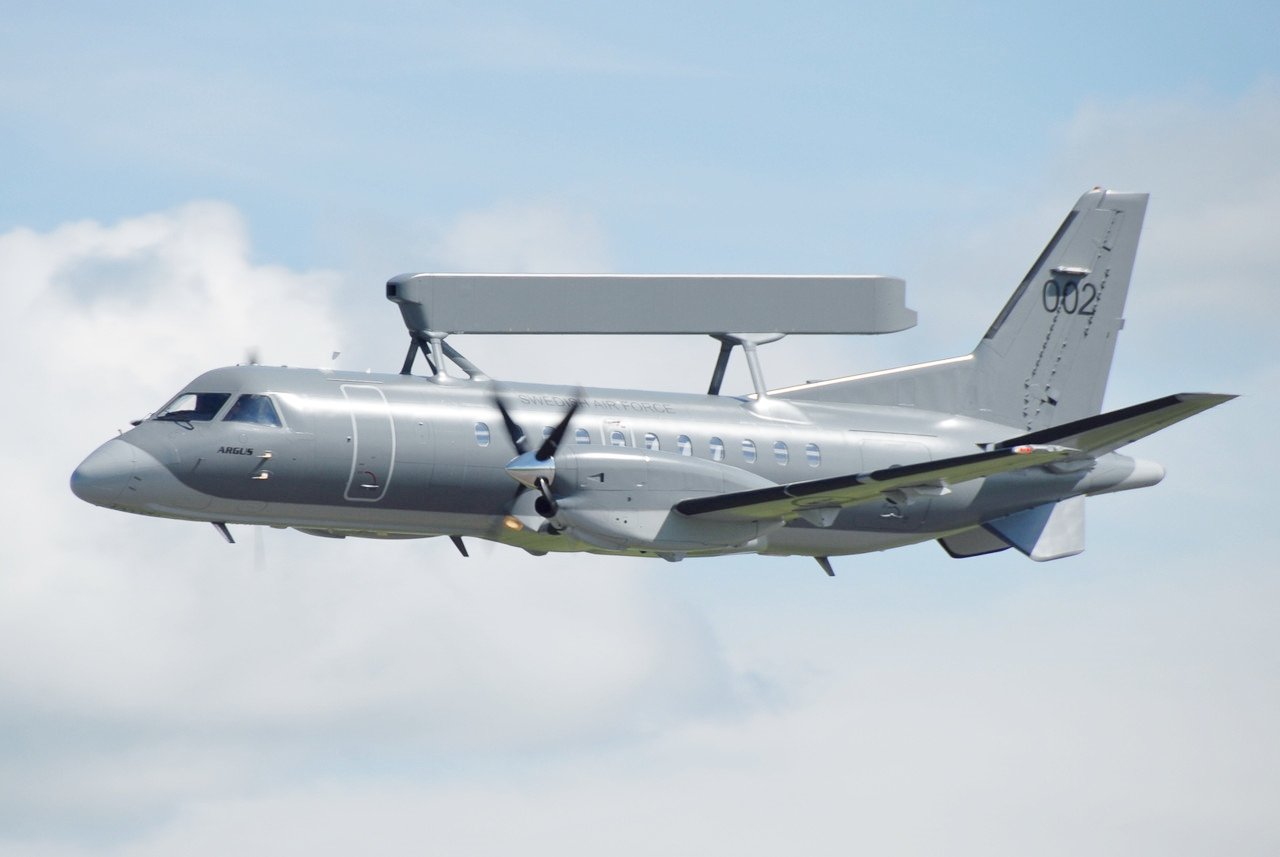
Saab 340 AEW&C (ASC 890) aircraft featuring the fixed rectangular Erieye AESA radar fairing on its fuselage.
The ASC 890’s dorsal PS-890 Erieye radar utilizes active electronically scanned array (AESA) technology, eliminating the mechanical delay of traditional rotating radomes. Image by: By Gnolam

This enhanced visibility serves as a direct countermeasure to Russia’s shifting aerial tactics. In July 2026 alone, Russia fired a record 474 missiles at Ukrainian targets. By deploying the ASC 890, Ukrainian operators can detect these incoming projectiles immediately post-launch, allowing ground-based interceptors and fighter jets to optimize their engagement windows.

Erieye AESA Radar Architecture

Unlike legacy airborne radars that rely on a rotating mechanical radome (such as the American AWACS or Russian A-50), the ASC 890 utilizes the PS-890 Erieye Active Electronically Scanned Array (AESA) system. Housed in a fixed rectangular dorsal fairing, the Erieye steers its radar beams electronically. This eliminates the mechanical scanning delay, delivering exceptionally fast update rates critical for tracking high-speed, low-RCS (Radar Cross Section) targets.
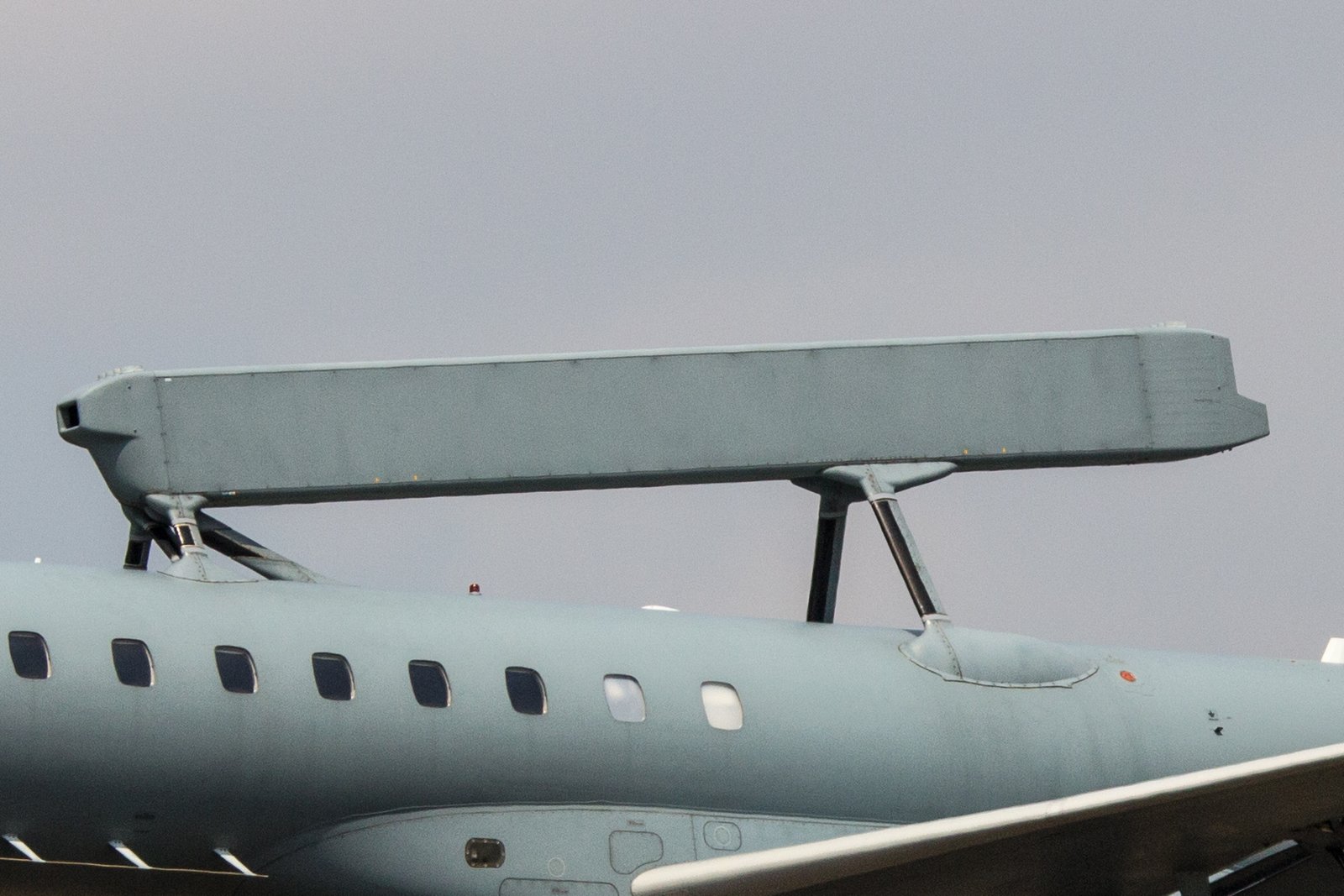
ASC 890 PS-890 Erieye radar
PS-890 Erieye radar. Image by: Steve Lynes.

Erasing Russia’s Airspace Dominance

The survival of the ASC 890 is a direct indictment of Russia’s forward air defense network. AEW&C aircraft emit massive electromagnetic signatures; they are the exact opposite of stealth. Despite its large radar cross-section and sluggish top speed of 530 km/h, Russia has completely failed to engage the aircraft during its six months of active combat duty. This failure points to a severely depleted localized SAM network, heavily attrited by Ukrainian SEAD (Suppression of Enemy Air Defenses) operations.

Asymmetric AEW&C Attrition

While Ukraine gains its first dedicated AEW&C platform, Russia is losing its own. Moscow started the conflict with roughly seven operational Beriev A-50 spy planes. In early 2024, Ukraine shot down two of these irreplaceable assets (January 15 and February 23) from extreme distances, forcing the remaining Russian fleet to retreat toward the Volga River. Pulled back to avoid Ukrainian interceptors, Russia’s A-50s can no longer provide effective forward fighter coordination.

Network-Centric Warfare & NATO Integration

Delivered as part of Sweden’s $1.25 billion military aid package (Package 16), the ASC 890 is more than a surveillance tool—it is a flying command post. The aircraft is optimized for network-centric warfare, designed to seamlessly link with Western-made tactical aviation. As Ukraine integrates F-16s, Mirage 2000s, and eventually Swedish Gripens into its Air Force, the ASC 890 will serve as the quarterback, coordinating beyond-visual-range (BVR) ambushes and vectoring fighters toward high-value Russian targets without requiring the jets to emit their own detectable radar signatures.

MetricSwedish ASC 890 (S 100D)Russian Beriev A-50U
Origin / GenerationSweden (Modernized AESA)Russia (Soviet-era upgrade)
Radar ArchitecturePS-890 Erieye AESA (Fixed Dorsal)Shmel-M (Rotating Mechanical Radome)
Max Detection Range~400 km~650 km (against large targets)
Service Ceiling7,620 m (25,000 ft)12,000 m (39,000 ft)
Maximum Speed530 km/h900 km/h
Endurance5 – 7 Hours9 Hours
Operational StatusActive in Ukraine (Uncontested)Severely Attrited (Forced away from front lines)

The ASC 890 is a supreme force multiplier. By overcoming the terrestrial radar horizon, Ukraine has systematically neutralized Russia’s low-altitude cruise missile penetration tactics. However, the most critical intelligence derived from this deployment is not the aircraft’s capability, but rather Russia’s structural vulnerability. An AEW&C aircraft is a massive, slow, highly luminescent electromagnetic target; the fact that the ASC 890 has operated unmolested for six months proves that Russia’s forward air defense umbrella is critically fractured. As Ukraine’s Western fighter fleet expands, the ASC 890 will transition from a defensive early-warning asset into an offensive aerial command node, firmly cementing Ukraine’s shift to NATO-standard, network-centric warfare.

Tags: NATOukraine russia war

Related Posts

LPP Holding autonomous drone platform displayed at a NATO defense innovation showcase
Unmanned & Autonomous Systems

LPP Wins NATO Challenge With AI Off-Grid Airfield Denial

October 2, 2026
Russian Prisedent Vladimir Putin
Europe

Russian Hybrid Escalation: Airspace Incursions and NATO Sabotage Accelerate

September 26, 2026
Canadian Army LAV VI armored vehicle operating during combat maneuvers.
Ground Forces & Armor

Canadian Army Reorganization: The 1st Manoeuvre Division ORBAT

September 20, 2026
Next Post
An advanced RSAF F-15SA Strike Eagle fighter jet equipped with precision-guided munitions

Saudi Air Strikes Escalation as Houthis Seize Red Sea Islands

Leave a Reply Cancel reply

Your email address will not be published. Required fields are marked *

I agree to the Terms & Conditions and Privacy Policy.

Latest Intelligence

Lunar South Pole Race: US and China Target Ice Reserves

Horten Ho 229 Technical Breakdown: WWII’s Jet Flying Wing and the Stealth Myth

Russia’s Rassvet Satellite Constellation Fails: Starlink Rival Crippled

Can Iran Reverse-engineering US Navy Anduril Dive LD Autonomous Submarine

US Navy Cancels Constellation Frigate: FFG-62 Procurement Disaster

B-17F Flying Fortress Technical Breakdown: Armor, Armament, and the Brutal Reality of Daylight Bombing

Domain Of Warfare

GJ 11 Chinese Drone
Unmanned & Autonomous Systems

China’s GJ-11 Sharp Sword: The Stealth UCAV Rewriting Indo-Pacific SEAD Operations

Rendered visualization of Boeing's tail-less sixth-generation carrier-based strike fighter concept
Air & Aerospace

US Navy Awards Boeing $20B F/A-XX Sixth-Gen Carrier Fighter Contract

LPP Holding autonomous drone platform displayed at a NATO defense innovation showcase
Unmanned & Autonomous Systems

LPP Wins NATO Challenge With AI Off-Grid Airfield Denial

M142 High Mobility Artillery Rocket System (HIMARS) fires a training rocket during a live-fire exercise in Undva, Estonia, July 11, 2025. The exercise included dry-firing, equipment staging, communication systems checks, and concluded with live-fire qualifications.
Naval & Maritime

US Army Expands HIMARS Role With PrSM Anti-Ship Strike

Defense Archives

Horten Ho 229 Technical Breakdown: WWII’s Jet Flying Wing and the Stealth Myth

The Horten Ho 229 V3 German Nazi Stealth Bomber in flight 1945

Developed during the final desperate months of World War II, the Horten Ho 229 remains one of the most visually...

Read moreDetails

B-17F Flying Fortress Technical Breakdown: Armor, Armament, and the Brutal Reality of Daylight Bombing

USAF The B-17F Flying Fortress

The Boeing B-17F Flying Fortress was the blunt-force instrument of the Allied daylight strategic bombing campaign over Europe. Tasked with...

Read moreDetails

B-17 Ball Turret Technical Breakdown: Firepower, Armor, and Survival

Cutaway diagram or close-up profile of a B-17 ball turret showing the fetal position of the gunner.

BOTTOM LINE UP FRONT Advanced Fire Control: The Sperry K-4 automatic computing gunsight calculated gravity, wind speed, aircraft velocity, and...

Read moreDetails

King Tiger Technical Breakdown: Firepower, Armor, and Flaws

Panzerkampfwagen VI Ausf. B King Tiger tank with Henschel turret in a field.

BOTTOM LINE UP FRONT Unmatched Stand-off Firepower: The 88 mm KwK 43 L/71 gun achieved 100% test accuracy at 1,000...

Read moreDetails

Frontline Defense is an independent, objective analysis platform. The content provided on this website, including but not limited to technical breakdowns, military hardware comparisons, defense budget reports, and open-source intelligence (OSINT) analyses, is strictly for educational, historical, and informational purposes. Frontline Defense is not affiliated with, endorsed by, or acting on behalf of any government agency, department of defense, armed forces branch, or defense contractor. All content on this site represents independent research based strictly on unclassified, publicly available data and open-source records at the time of writing. Nothing published on this website should be construed as official military guidance, defense strategy consulting, or government policy.

Follow Us

Domain Of Warfare

  • Naval & Maritime
  • Air & Aerospace
  • Ground Forces & Armor
  • Strategic Weapons
  • Unmanned & Autonomous Systems

Regions

  • USA & Americas
  • Europe
  • Middle East
  • Asia & Pacific
  • About Us
  • Privacy Policy
  • Terms Of Use

© 2026 | Fronline Defense Journal. All Rights Reserved

No Result
View All Result
  • Home
  • Latest Intelligence
  • Domain Of Warfare
    • Naval & Maritime
    • Air & Aerospace
    • Ground Forces & Armor
    • Unmanned & Autonomous Systems
    • Strategic Weapons
  • Regions
    • USA & Americas
    • Europe
    • Middle East
    • Asia & Pacific
  • Defense Archives
  • About Us
    • Who We Are
    • Privacy Policy
    • Terms Of Use

© 2026 | Fronline Defense Journal. All Rights Reserved