
BOTTOM LINE UP FRONT
- WWI & The All Arms Concept (1916-1918): Prompted by massive losses at the Somme, the British Army moved away from monolithic rifle platoons, introducing specialized sections featuring Lewis guns, rifle bombers, hand bombers, and riflemen.
- WWII & The Bren Era (1938-1950s): The introduction of the Bren light machine gun revolutionized section tactics. Sections reorganized around a dedicated Bren group (providing fire support) and a rifle group (conducting the assault), a doctrine that persisted for decades.
- Cold War & The SLR (1950s-1980s): The transition to the 7.62mm NATO L1A1 SLR and the L4/L7 GPMG redefined section firepower. While early models maintained the Bren group concept, the introduction of the GPMG eventually necessitated dedicated gun groups within the section structure.
- The SA80 & Fire Teams (1980s-2000s): The adoption of the 5.56mm SA80 family (L85 rifle and L86 LSW) allowed the section to split into two balanced, mutually supporting fire teams (Charlie and Delta), mirroring modern maneuver warfare concepts.
- Modern Era & Precision Suppression (2018-Present): Dissatisfaction with the 5.56mm Minimi led to a controversial restructuring. Today, sections rely on the 7.62mm L129A1 Sharpshooter rifle for point suppression and the venerable L7A2 GPMG for area suppression, supported by modernized L85A3 rifles and NLAW anti-tank systems.
WWI: The Birth of the “All Arms” Section
Before 1916, British tactical doctrine at the small-unit level was rudimentary. Platoons were large, unwieldy blocks of riflemen armed uniformly with Short Magazine Lee-Enfield (SMLE) bolt-action rifles. The devastating attrition of the Battle of the Somme catalyzed a doctrinal revolution.
In February 1917, the British published new doctrine establishing specialized sections within the platoon to create an “all arms” capability at the lowest tactical level:
- Rifle Section: Dedicated riflemen and forward scouts.
- Lewis Gun Section: Armed with one Lewis light machine gun.
- Hand Bomber Section: Specialized in close-quarters grenade throwing.
- Rifle Bomber Section: Equipped with rifle grenade dischargers for indirect fire.
This shifted tactical maneuver from the battalion down to the platoon, allowing riflemen and hand bombers to assault under the covering fire of the Lewis guns and rifle bombers. By late 1918, due to manpower shortages and tactical refinements, this consolidated into a balanced platoon of two rifle sections and two Lewis gun sections, providing a mix of “bayonet power” and “firepower.”
WWII: The Bren Group Doctrine
The defining shift of the interwar and WWII period was the introduction of the Bren light machine gun in 1938. Significantly more portable than the WWI Lewis gun, the Bren allowed for the decentralization of automatic firepower directly into the rifle sections.
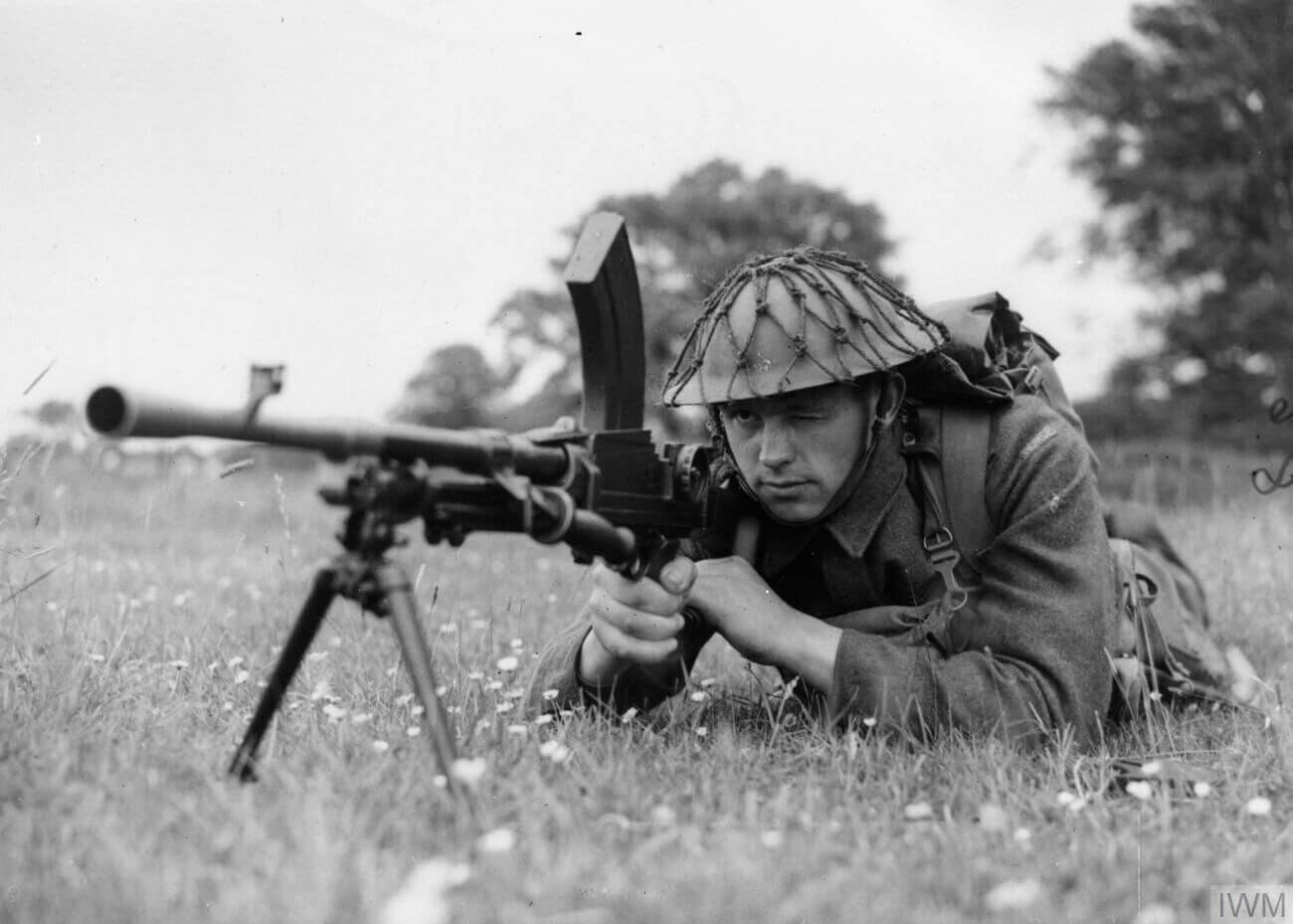
By 1943, the 10-man section stabilized into a structure that would define British infantry tactics for 40 years:
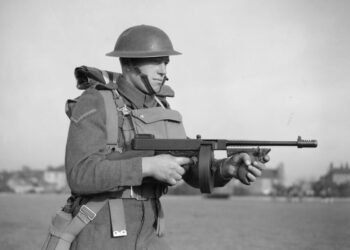
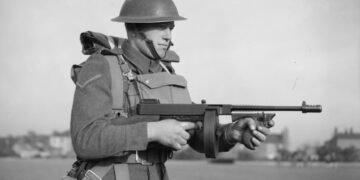
- Section Commander (Corporal): Armed with a Thompson or Sten submachine gun, leading the rifle group.
- Rifle Group (6 Privates): Armed with SMLE or No. 4 Mk 1 rifles for the assault.
- Bren Group (Lance Corporal + 2 Privates): Commanded by the 2IC, operating the Bren gun to provide a base of fire.
This allowed the section to maneuver dynamically, with the Bren group suppressing the enemy while the rifle group flanked and assaulted.
The Cold War: 7.62mm and the GPMG
The late 1950s brought the nuclear age and severe budget cuts, ending national conscription. It also brought a total overhaul of infantry weaponry. In 1957, the British Army adopted the 7.62mm NATO L1A1 Self-Loading Rifle (SLR), replacing the bolt-action Lee-Enfield.
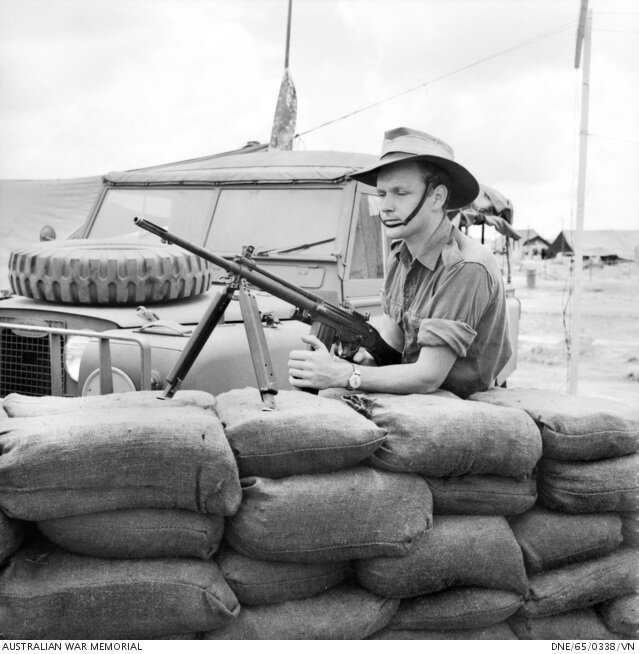
The Bren was initially rechambered to 7.62mm (as the L4), but the true paradigm shift occurred with the introduction of the L7A1 General Purpose Machine Gun (GPMG) in 1963. The GPMG provided devastating belt-fed firepower but required dedicated control. By 1968, doctrine formalized that the Section 2IC would command the gun group, allowing the Section Commander to focus entirely on maneuvering the rifle group. Anti-armor capability was also modernized with the introduction of the M72 LAW (L1A1 rocket) and the 84mm Carl Gustaf.
The SA80 Era: The Shift to Fire Teams
Through the 1970s, operations in Northern Ireland (Operation Banner) highlighted the need for flexible, independent four-man teams (“bricks”). However, applying these counter-insurgency tactics to conventional warfighting required a new weapons family.
In the mid-1980s, the adoption of the 5.56mm SA80 family (the L85A1 rifle and L86A1 Light Support Weapon) allowed the section to be split into two perfectly balanced, 4-man fire teams: Charlie Team (under the Corporal) and Delta Team (under the Lance Corporal). Both teams now possessed equal automatic firepower (one LSW each), allowing them to “leapfrog” and mutually support one another seamlessly.
Afghanistan and Modernization (2000s–2026)
Combat in Afghanistan highlighted the SA80 family’s initial reliability issues and the LSW’s inadequacy as a volume-fire weapon. The LSW was subsequently replaced by the FN Minimi (L110A1) in 2004, providing belt-fed suppression at the fire team level. Concurrently, underslung grenade launchers (L123A1) were integrated.
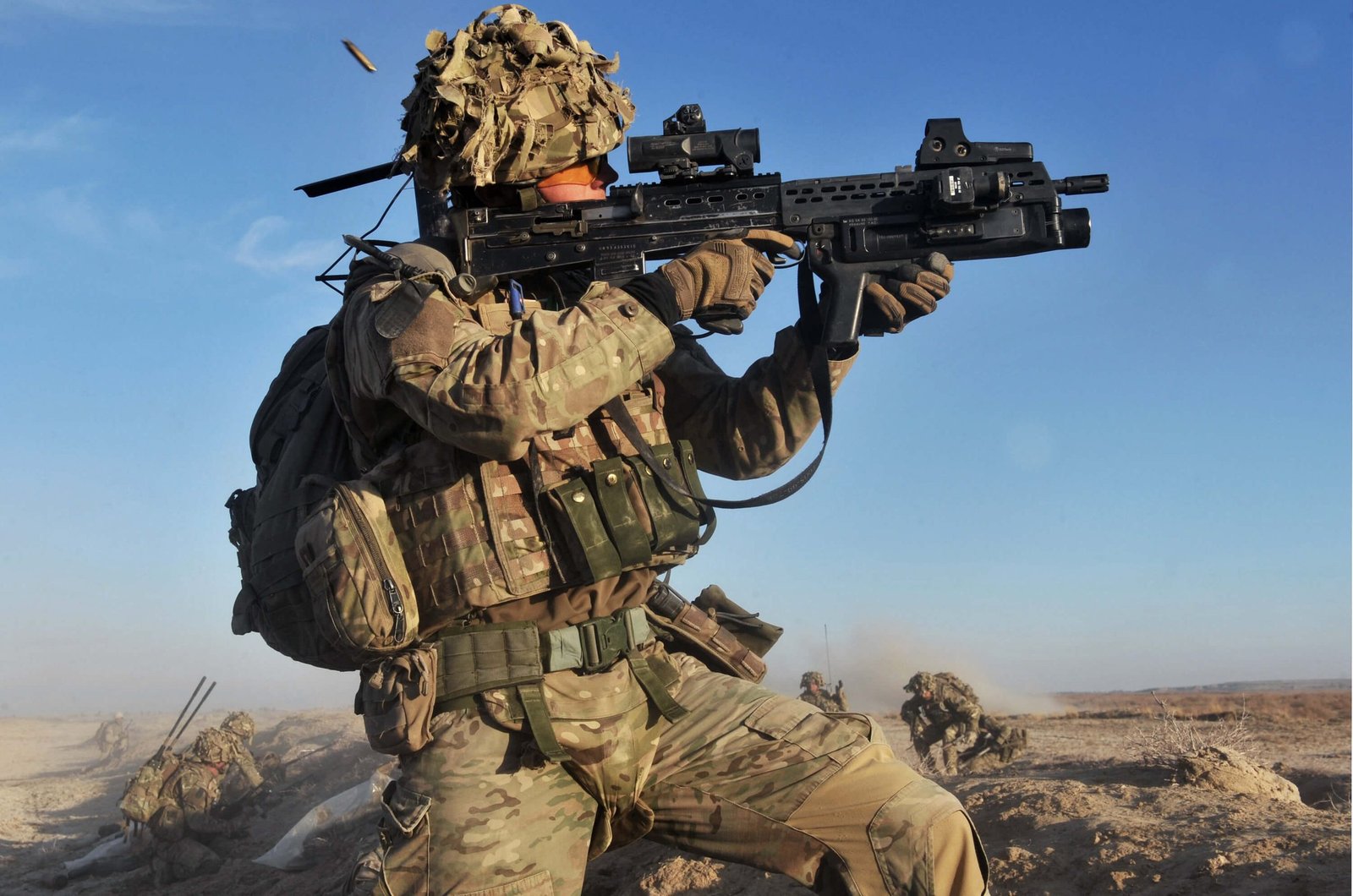
However, the long engagement ranges in Helmand Province forced another shift. The L129A1 Sharpshooter rifle was introduced to provide precision fire out to 800 meters.
The 2018 Shakeup: In a controversial move mirroring the US Marine Corps’ shift toward precision suppression, the British Army phased out the 5.56mm Minimi at the section level, arguing it lacked effective range and added unnecessary weight. Today, the standard British infantry section operates with a mix of precision and heavy area suppression:
- Charlie/Delta Teams: Equipped with modernized L85A3 rifles and underslung grenade launchers.
- Point Suppression: Provided by the 7.62mm L129A1 Sharpshooter rifle.
- Area Suppression: The Cold War-era 7.62mm L7A2 GPMG has returned to the section level.
- Anti-Armor: Sections are generally equipped with the highly effective NLAW (Next generation Light Anti-tank Weapon).
Evolution of the British Infantry Section (Key Eras)
| Era (Year) | Primary Section Weapons | Doctrinal Structure | Key Tactical Shift |
| WWI (1917) | SMLE, Lewis Gun, Grenades | Specialized sections within platoon | Birth of the “All Arms” platoon; decentralized maneuver. |
| WWII (1943) | SMLE / No. 4, Bren LMG, Sten | Rifle Group & Bren Group | Dedicated base of fire supporting a maneuver/assault element. |
| Cold War (1968) | L1A1 SLR, L7 GPMG, M72 LAW | Rifle Group & Gun Group (under 2IC) | Shift to 7.62mm NATO; massive increase in volume of fire. |
| Late Cold War (1985) | L85A1, L86 LSW, LAW 80 | Two equal 4-man Fire Teams (Charlie/Delta) | Shift to 5.56mm; symmetrical fire teams capable of leapfrogging. |
| Modern (2026) | L85A3, L129A1 Sharpshooter, L7 GPMG, NLAW | Two Fire Teams (Asymmetrical weapons load) | Removal of 5.56mm Minimi; reliance on precision (Sharpshooter) and heavy suppression (GPMG). |
The British Army infantry section has continuously oscillated between prioritizing raw volume of fire and precision maneuverability. The WWI and WWII eras decentralized automatic weapons to the lowest level to enable maneuver. The SA80 era sought perfect symmetry between fire teams. However, the modern 2026 configuration represents a hybrid approach, learned from the long sightlines of Afghanistan. By ditching the 5.56mm LMG in favor of the 7.62mm Sharpshooter rifle and the heavy GPMG, the modern section doctrine wagers that accurate, high-caliber point suppression—backed by advanced anti-armor systems like the NLAW—is more lethal and effective on the modern battlefield than sheer 5.56mm volume.