BOTTOM LINE UP FRONT
- Mothership Integration: The M2A4 Bradley is actively fielding 5+ side-mounted FireAnt UGVs, transforming it from a traditional troop carrier into a forward-deployed robotic C2 node.
- Cost Asymmetry: At an estimated $50,000 unit cost, FireAnt UGVs offer an expendable alternative to multi-million-dollar armor, saturating contested zones without risking human personnel.
- Combat Configuration: Weighing roughly 60 lbs (27 kg), FireAnts operate modular payloads, including loitering munitions, Explosively Formed Penetrators (EFPs), and M72 LAW-equivalent recoilless rifles.
- Networked Autonomy: The swarm utilizes a decentralized mesh network, allowing a single operator to command 6 to 10 autonomous nodes simultaneously across mixed combat domains.
- Strategic Modernization: Testing falls under the Army’s Transformation in Contact (TIC) initiative and Replicator framework, directly applying UGV battlefield lessons learned from the conflict in Ukraine.
The M2A4 Bradley’s Evolution to Robotic Mothership
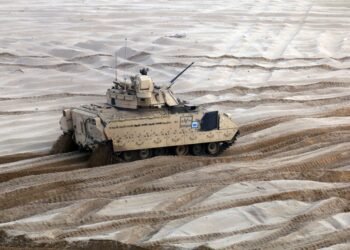
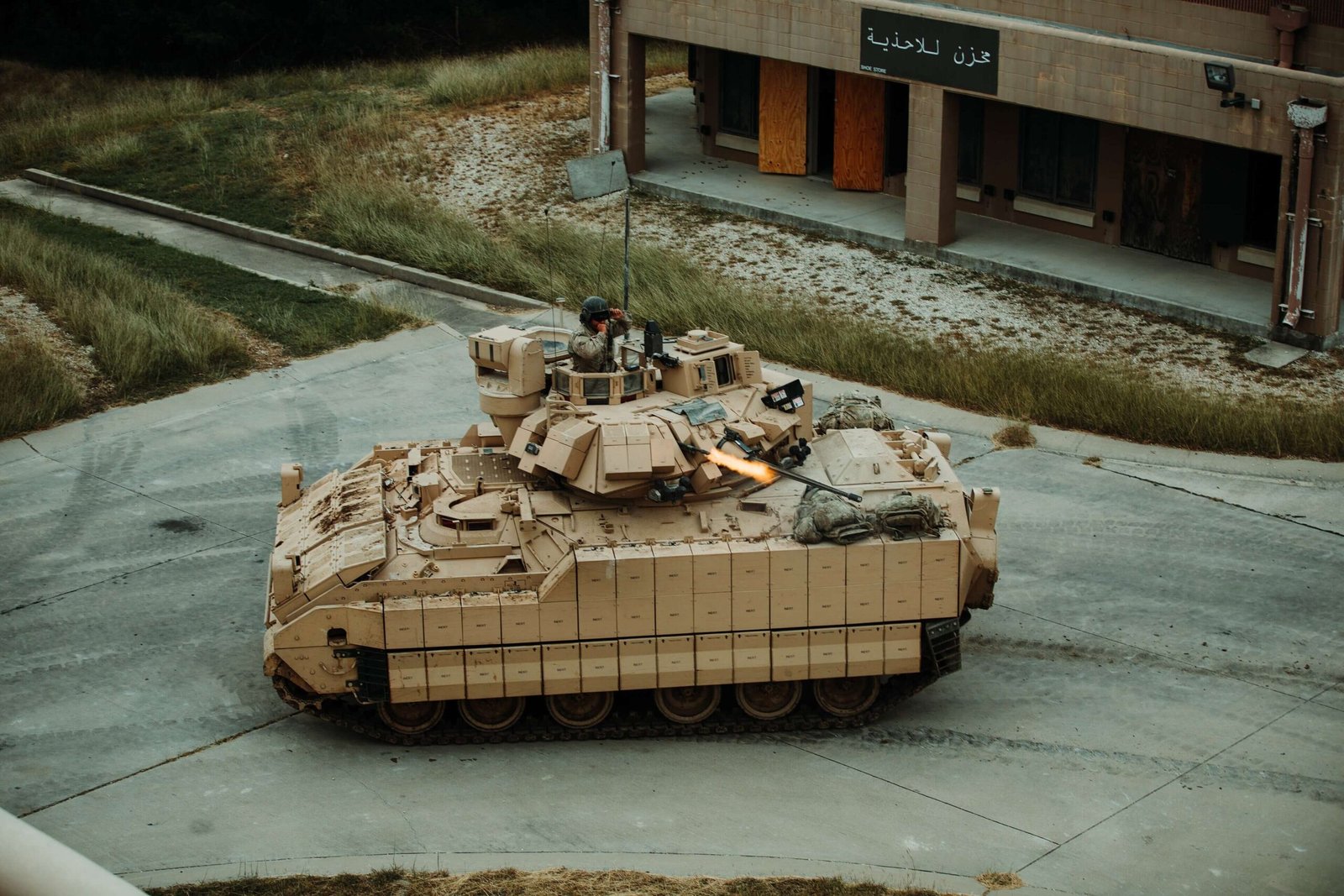
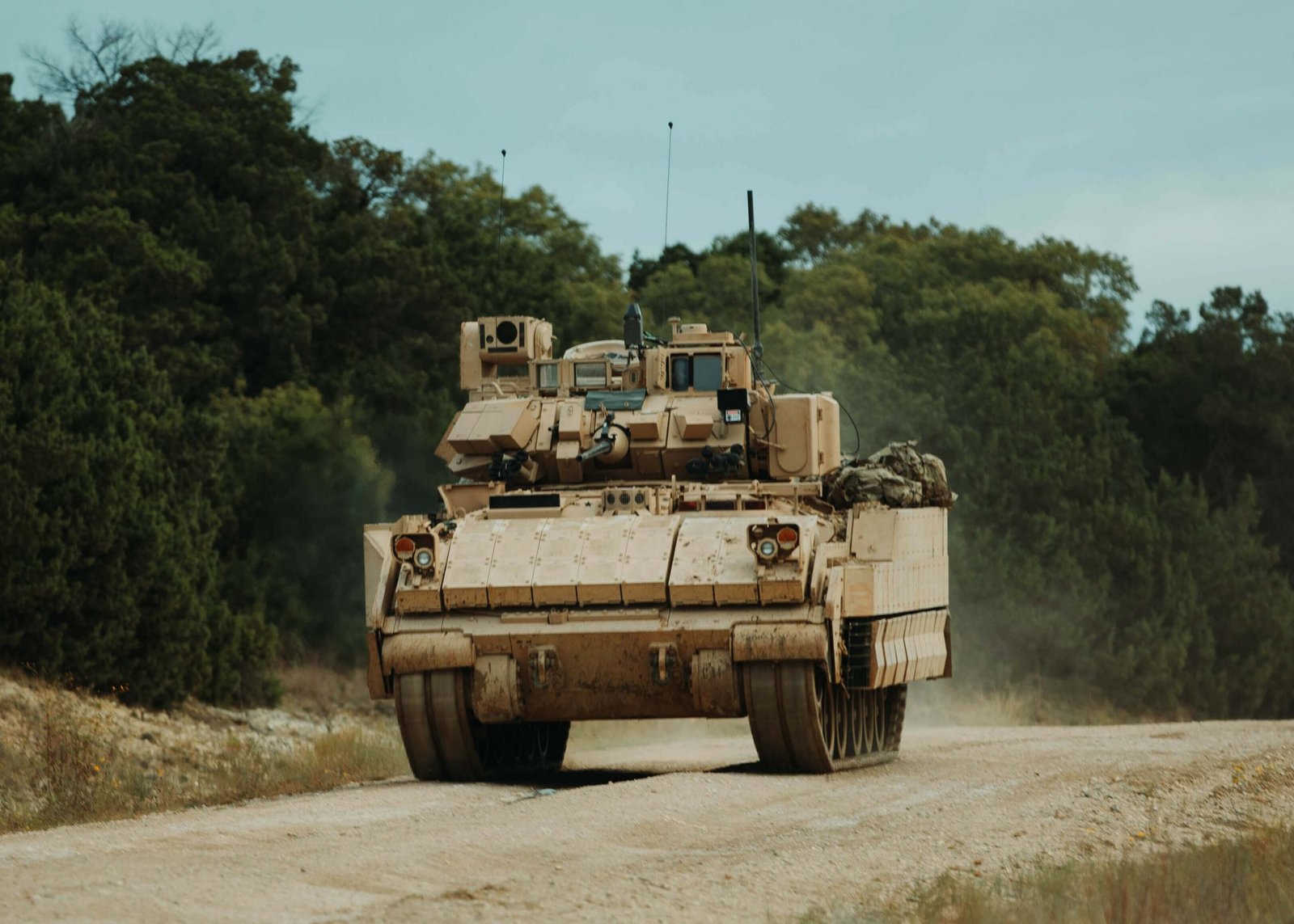
The traditional doctrine of mechanized infantry is undergoing a rapid structural shift. Instead of risking a highly valuable M2A4 Bradley and its crew against cheap, asymmetric FPV drones, the U.S. Army is fielding a standoff robotic assault layer. During the Transformation in Contact (TIC) modernization phase, the 1st Cavalry Division successfully integrated multiple small robotic systems directly onto the hull of a frontline armored platform.
Footage from the Pegasus Charge 3 exercise reveals an M2A4 Bradley carrying five Swarmbotics AI FireAnt UGVs vertically mounted on its side. This capability allows the Bradley to release a ground swarm at the forward edge of the battle area. These robots advance to map terrain, trigger mines, blind enemy radar, and strike protected bunkers well before soldiers dismount into the kill zone.
Technical Profile: Swarmbotics AI FireAnt SUGV
The Swarmbotics AI FireAnt is specifically engineered for high-risk, zero-return missions. With a length of 3.3 feet and weighing approximately 60 lbs (27 kg), the low-silhouette all-terrain chassis is powered by a hybrid electric drive. This configuration yields a minimal thermal signature while maintaining high mobility in urban debris and mud, bypassing the logistical footprint of heavier combat platforms.
Durability is baked into the platform’s hardware. The FireAnt meets strict IP67 protection standards, meaning the chassis is completely sealed against dust and temporary water immersion. Hardened to resist extreme heat, vibration, and shock, the SUGV can easily survive the violent deployment transition from a Bradley hull directly into an active firefight.
Networked Swarm Autonomy and Payload Modularity
Swarmbotics AI built the FireAnt around rapid, in-field modularity. The base payload supports ISR sensor suites, electronic warfare jammers, and highly lethal anti-armor configurations. Kinetic options include loitering munitions, Explosively Formed Penetrator (EFP) devices, and a lightweight recoilless rifle optimized for side and rear armor penetration.
The overwhelming tactical advantage lies in the software. Integrating with Robot Operating System 2 (ROS 2) and the Joint Architecture for Unmanned Systems (JAUS), a single operator can command a decentralized mesh network of 6 to 10 UGVs. The integrated AI handles object classification, dynamic target acquisition, and coordinated spacing, enabling the swarm to function semi-independently even in heavy GPS-degraded zones.
Operational Impact: Mass, Attritability, and Lethality
By integrating FireAnts into mechanized units, the U.S. Army creates an immediate asymmetric dilemma for near-peer adversaries. Hostile forces must now actively track, classify, and prioritize dozens of decentralized robotic nodes rather than a single Bradley. This aligns seamlessly with the Pentagon’s Replicator initiative, which seeks to saturate the battlefield with mass-produced, expendable autonomous systems.
At a projected average cost of $50,000 per unit, deploying a swarm of FireAnts achieves a highly favorable cost-to-kill ratio. Borrowing heavily from drone attrition strategies currently employed in Ukraine, the U.S. strategy shifts the initial contact risk entirely onto machines, preserving priceless human capital and multi-million-dollar armor assets.
| Specification | M2A4 Bradley (Mothership) | Swarmbotics AI FireAnt (SUGV) |
| Role | Infantry Fighting Vehicle / C2 Node | Attritable Ground Swarm Robot |
| Combat Weight | ~30.4 short tons (60,800 lbs) | ~60 lbs (27 kg) |
| Primary Armament | 25mm M242 Bushmaster, TOW Missiles | EFP, Loitering Munitions, Recoilless Rifle |
| Crew / Operation | 3 Crew + 6 Infantry | 1 Operator commands 6–10 UGVs |
| Unit Cost | Multi-Million Dollars | ~$50,000 (Estimated) |
| Key Capability | Heavy Armor, Troop Transport | IP67 Sealed, AI-Powered Mesh Network |
| Strategic Advantage | Survivability, Deep Firepower | Mass, Expendability, ISR, EW |
FORCE MULTIPLIER & SURVIVABILITY ENHANCER. Integrating FireAnt swarms onto the M2A4 Bradley fundamentally transforms heavy armor doctrine. By physically linking cheap, lethal mass (SUGVs) to highly survivable C2 platforms (Bradleys), the Army pushes the line of contact forward without exposing troops. This crude-to-uncrewed teaming effectively mitigates the structural vulnerability of multi-million-dollar armor to asymmetric FPV threats, offering a scalable, highly lethal, and rapidly deployable screening force for mechanized infantry.