Frontline Defense Journal | Objective OSINT & Military Analysis
  • Home
  • Latest Intelligence
  • Domain Of Warfare
    • Naval & Maritime
    • Air & Aerospace
    • Ground Forces & Armor
    • Unmanned & Autonomous Systems
    • Strategic Weapons
  • Regions
    • USA & Americas
    • Europe
    • Middle East
    • Asia & Pacific
  • Defense Archives
  • About Us
    • Who We Are
    • Privacy Policy
    • Terms Of Use
No Result
View All Result
  • Home
  • Latest Intelligence
  • Domain Of Warfare
    • Naval & Maritime
    • Air & Aerospace
    • Ground Forces & Armor
    • Unmanned & Autonomous Systems
    • Strategic Weapons
  • Regions
    • USA & Americas
    • Europe
    • Middle East
    • Asia & Pacific
  • Defense Archives
  • About Us
    • Who We Are
    • Privacy Policy
    • Terms Of Use
Frontline Defense Journal | Objective OSINT & Military Analysis
No Result
View All Result
Frontline Defense Journal | Objective OSINT & Military Analysis
No Result
View All Result
Home Domain Of Warfare Air & Aerospace

USAF Tanker Crisis: KC-46 Flaws Threaten Global Reach

September 9, 2026
Reading Time: 5 mins read
A A
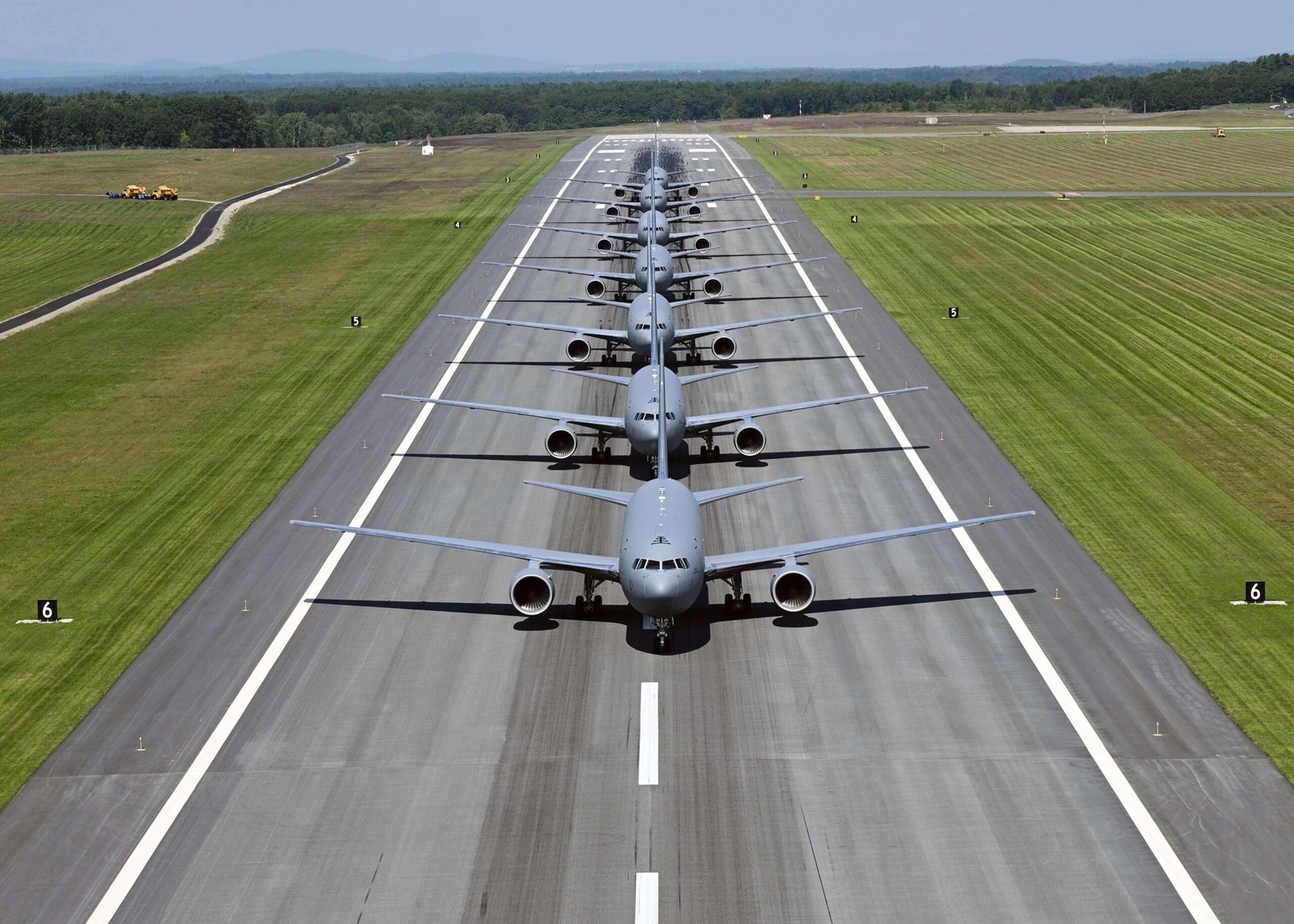
KC-46 Pegasus from Pease Air National Guard Base, N.H.
Share on FacebookShare On Reddit

BOTTOM LINE UP FRONT

  • Degraded Readiness: Total fleet full-mission-capable rates have plummeted since 2019, with recent 2024 metrics showing the KC-135 at 69% and the KC-46 at just 65%.
  • Hardware Failure: The KC-46’s Remote Vision System (RVS) remains operationally defective, plagued by visual distortion and depth-perception flaws; the RVS 2.0 replacement is delayed until 2028.
  • Cannibalization Crisis: Maintainers are aggressively stripping grounded KC-135 “hangar queens” for spare parts due to entirely depleted legacy supply chains.
  • Vendor Data Lock: Boeing maintains strict proprietary control over KC-46 technical maintenance data, forcing frontline maintainers to rely on slow civilian contractor approvals for basic operational repairs.
  • Delayed Force Scaling: The USAF’s full-rate production decision for the 263-aircraft KC-46 fleet is delayed until late 2026—nine years behind schedule.

The “Franken-Tanker” Procurement Failure

In 2011, Boeing secured a $35 billion contract to deliver 179 KC-46 Pegasus aircraft to partially relieve the USAF’s aging fleet of approximately 370 KC-135s. However, rather than an off-the-shelf adaptation of the commercial 767 airliner, the KC-46 became an uncoordinated amalgamation of disjointed systems.

The airframe fuses a fuselage, flight deck, and landing gear from three distinct 767 variants, pairs them with 787 cockpit displays, and integrates the refueling boom from the retired KC-10 Extender. This disjointed architecture resulted in immediate compounding failures: fuel lines leaked, floor cargo locks unlatched mid-flight, and early warning radars failed to distinguish friend from foe.
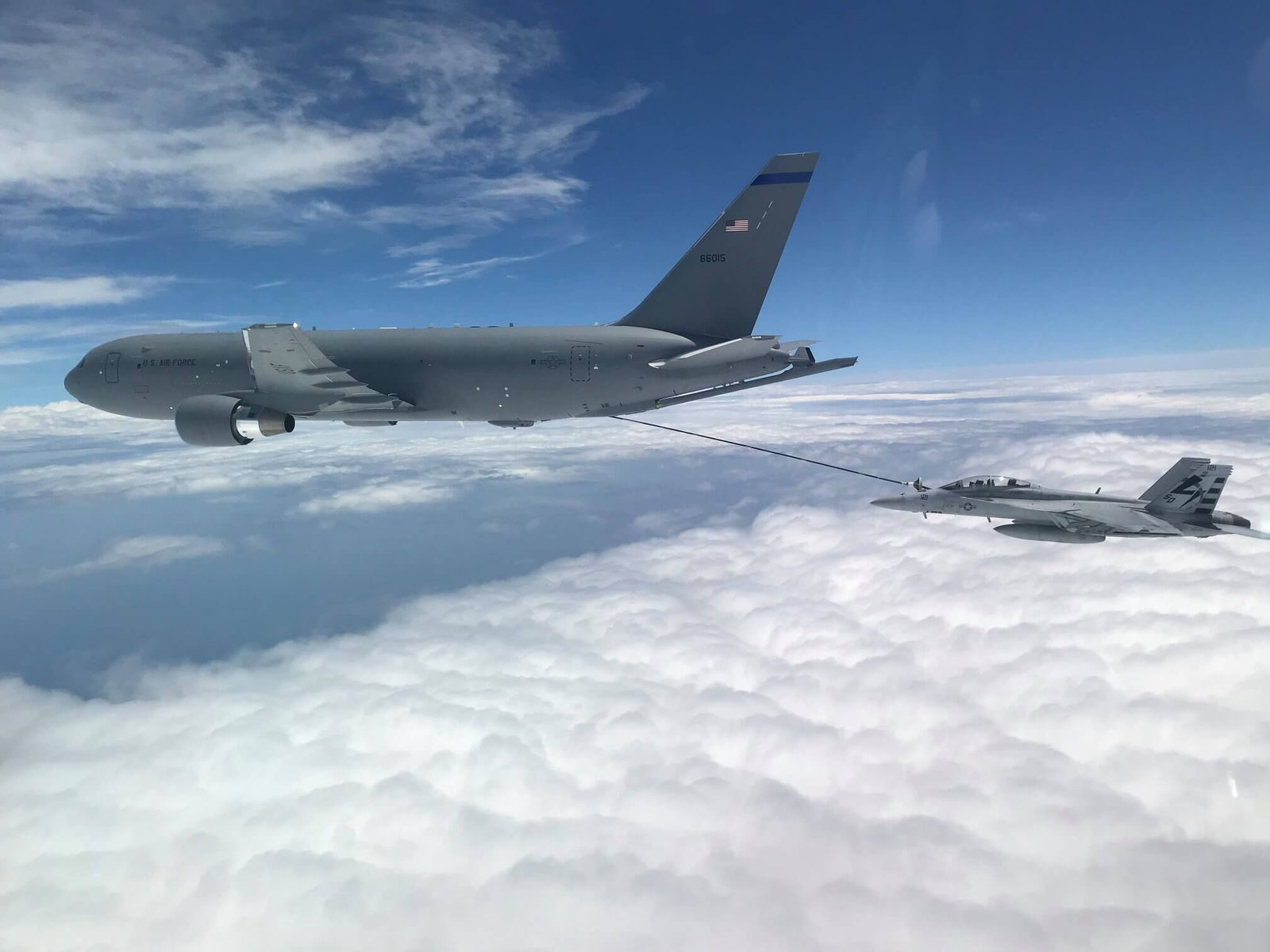
New Hampshire-based KC-46A aircrew refuel a U.S. Navy F/A-18F Super Hornet. This marked the first time the aircrew utilized the KC-46A centerline drogue system to refuel an aircraft.
The KC-46 Pegasus was intended to revolutionize USAF global reach, but critical hardware failures and a 9-year schedule delay have severely hampered its operational integration. Source: U.S. Air Force

The RVS Defect and Vendor Lock

The most critical capability gap of the KC-46 is its Remote Vision System (RVS). Bypassing the traditional physical window used by KC-135 boom operators, the KC-46 relies on external cameras and a 3D display. In varying lighting conditions, the RVS distorts target imagery and eliminates depth perception, creating unacceptable mid-air collision risks, particularly for stealth platforms requiring pristine radar-absorbent coatings.

Compounding the hardware failures is a restrictive “Right to Repair” environment. Boeing maintains strict vendor lock over the aircraft’s technical data. Maintainers cannot legally access basic inspection criteria for the Pratt & Whitney engines without navigating dense contractor bureaucracy, leaving frontline combat units entirely reliant on civilian supply chains in active theaters.

Fleet Attrition and Infrastructure Gaps

With the KC-46 sidelined from maximum deployment, the operational burden has fallen back onto the 60-year-old KC-135 Stratotanker. The increased operational tempo has shattered legacy supply chains, forcing Airmen to cannibalize functional parts from grounded aircraft to keep active squadrons flying.

Furthermore, the USAF based KC-46 lifecycle modeling on civilian airline metrics, failing to account for the harsh realities of military aviation. Civilian jets operate from climate-controlled hangars on predictable routes. In contrast, the KC-46 is forced into austere, corrosive environments without adequate infrastructure; the Government Accountability Office (GAO) recently confirmed the USAF failed to build enough hangars sized to house the larger Pegasus airframe.

USAF Aerial Refueling Assets (2024 Metrics)

PlatformActive Fleet SizeMission Capable RateCritical DeficienciesTactical Impact
KC-135 Stratotanker~370 Airframes69%Age-related structural fatigue, obsolete supply chains.Severe parts cannibalization; high maintenance downtime limits global sortie generation.
KC-46 Pegasus~107 Airframes65%RVS distortion, faulty cargo locks, restrictive tech data (Vendor Lock).Inability to refuel all platforms (e.g., A-10); maintenance bottlenecked by contractor red tape.

The U.S. military’s aerial refueling capability is currently a high-risk structural vulnerability. Air power doctrine requires continuous, high-volume fuel staging to maneuver short-legged fighter platforms across oceans and project bomber fleets deep into contested airspace. The KC-46 Pegasus program demonstrates a catastrophic failure of the defense acquisition process, prioritizing optimistic contractor timelines over concrete capability delivery. Until the Department of Defense shatters proprietary vendor lock to empower frontline maintainers and accelerates the deployment of RVS 2.0, American air power will remain tethered to an aging, cannibalized legacy fleet entirely ill-equipped for a high-intensity peer conflict.

Tags: LogisticsUSAF

Related Posts

Critical Fuel Shortages Paralyze Ukrainian Combat Operations on the Southern Front
Europe

Critical Fuel Shortages Paralyze Ukrainian Combat Operations on the Southern Front

September 10, 2026
Boeing F-47 NGAD: How America’s Sixth-Generation Fighter Defeats the Indo-Pacific Dilemma
Air & Aerospace

Boeing F-47 NGAD: How America’s Sixth-Generation Fighter Defeats the Indo-Pacific Dilemma

September 7, 2026
Next Post
U.S. Navy Arleigh Burke-class guided-missile destroyer USS Carney Firing SM-6 Interceptor

Iran Fires Qasem Basir ASBM at US Navy as Houthis Strike Saudi Aramco

Leave a Reply Cancel reply

Your email address will not be published. Required fields are marked *

I agree to the Terms & Conditions and Privacy Policy.

Latest Intelligence

NATO’s 3-Stage Baltic Defense Plan: Countering Russia’s Geran-5 Drone Escalation

Critical Fuel Shortages Paralyze Ukrainian Combat Operations on the Southern Front

IRGC Captures Navy Dive-LD Drone: Technical & Intel Analysis

Operation Red Dawn: The Human Intel Strategy That Captured Saddam Hussein

WWII Tank Production Costs: Panzer IV to T-34 Analyzed

USS John F. Kennedy (CVN-79) Sea Trials: Tech Specs, Cost & Fleet Impact

Domain Of Warfare

F-16 fighter jet performing combat air patrol over NATO's eastern flank.
Europe

NATO’s 3-Stage Baltic Defense Plan: Countering Russia’s Geran-5 Drone Escalation

Critical Fuel Shortages Paralyze Ukrainian Combat Operations on the Southern Front
Europe

Critical Fuel Shortages Paralyze Ukrainian Combat Operations on the Southern Front

Frontline Defense is an independent, objective analysis platform. The content provided on this website, including but not limited to technical breakdowns, military hardware comparisons, defense budget reports, and open-source intelligence (OSINT) analyses, is strictly for educational, historical, and informational purposes. Frontline Defense is not affiliated with, endorsed by, or acting on behalf of any government agency, department of defense, armed forces branch, or defense contractor. All content on this site represents independent research based strictly on unclassified, publicly available data and open-source records at the time of writing. Nothing published on this website should be construed as official military guidance, defense strategy consulting, or government policy.

Follow Us

Domain Of Warfare

  • Naval & Maritime
  • Air & Aerospace
  • Ground Forces & Armor
  • Strategic Weapons
  • Unmanned & Autonomous Systems

Regions

  • USA & Americas
  • Europe
  • Middle East
  • Asia & Pacific
  • About Us
  • Privacy Policy
  • Terms Of Use

© 2026 | Fronline Defense Journal. All Rights Reserved

No Result
View All Result
  • Home
  • Latest Intelligence
  • Domain Of Warfare
    • Naval & Maritime
    • Air & Aerospace
    • Ground Forces & Armor
    • Unmanned & Autonomous Systems
    • Strategic Weapons
  • Regions
    • USA & Americas
    • Europe
    • Middle East
    • Asia & Pacific
  • Defense Archives
  • About Us
    • Who We Are
    • Privacy Policy
    • Terms Of Use

© 2026 | Fronline Defense Journal. All Rights Reserved