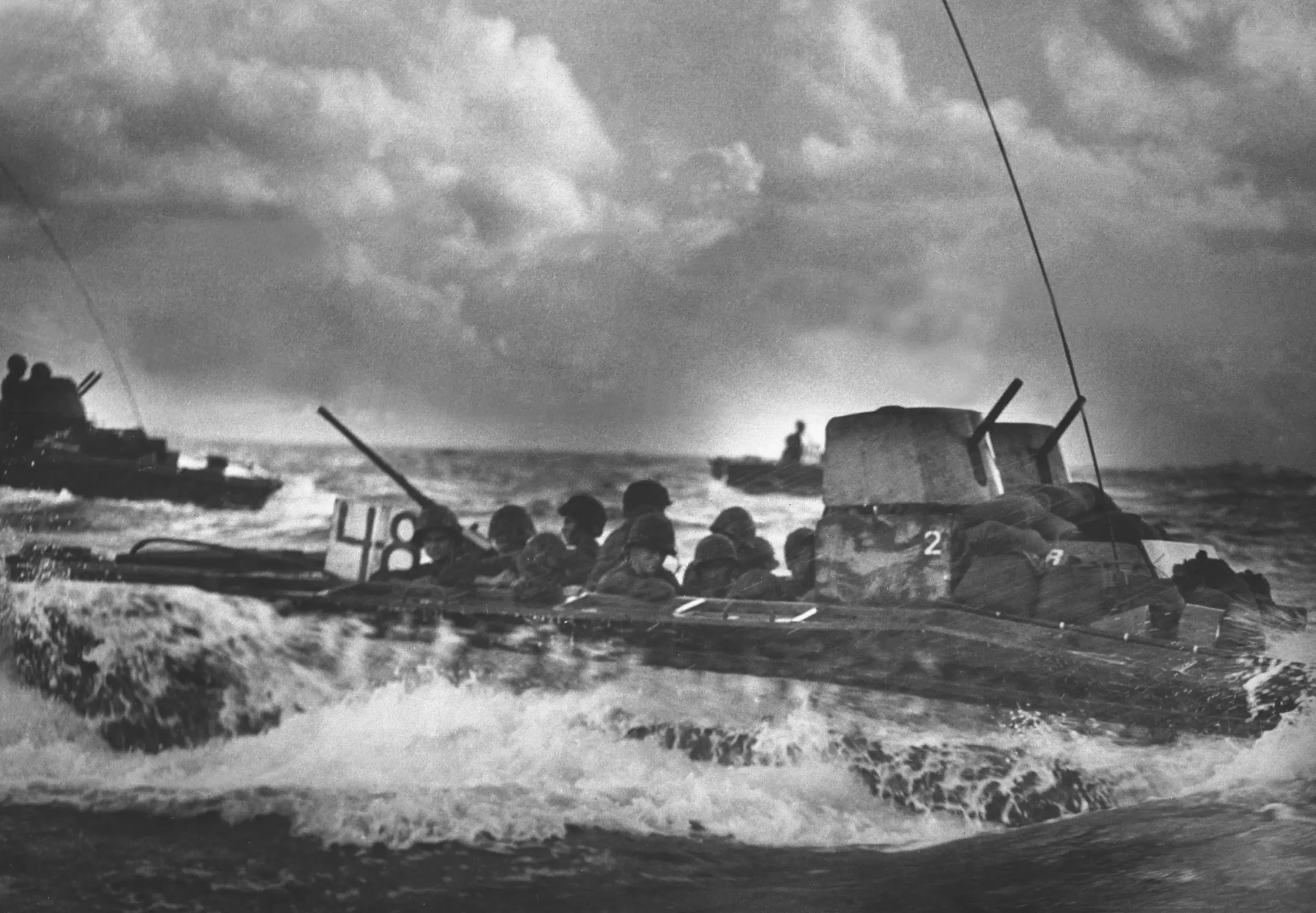
Bottom Line Up Front
- Catastrophic Force Contraction: Active-duty USMC personnel collapsed from a wartime peak of 485,000 in August 1945 to just 93,000 by June 1947.
- Structural Shift: The traditional three-regiment structure was abolished, replaced by 6 self-sustaining, independent infantry battalions, designed to form autonomous BLTs.
- Manning Deficits: The peacetime J-Series division authorized only 10,569 personnel, a massive reduction of 8,607 troops compared to the WWII G-Series configuration.
- Nuclear Mitigation: Decentralized command nodes and dispersed combat forces were engineered specifically to reduce target density on a nuclear-contaminated battlefield.
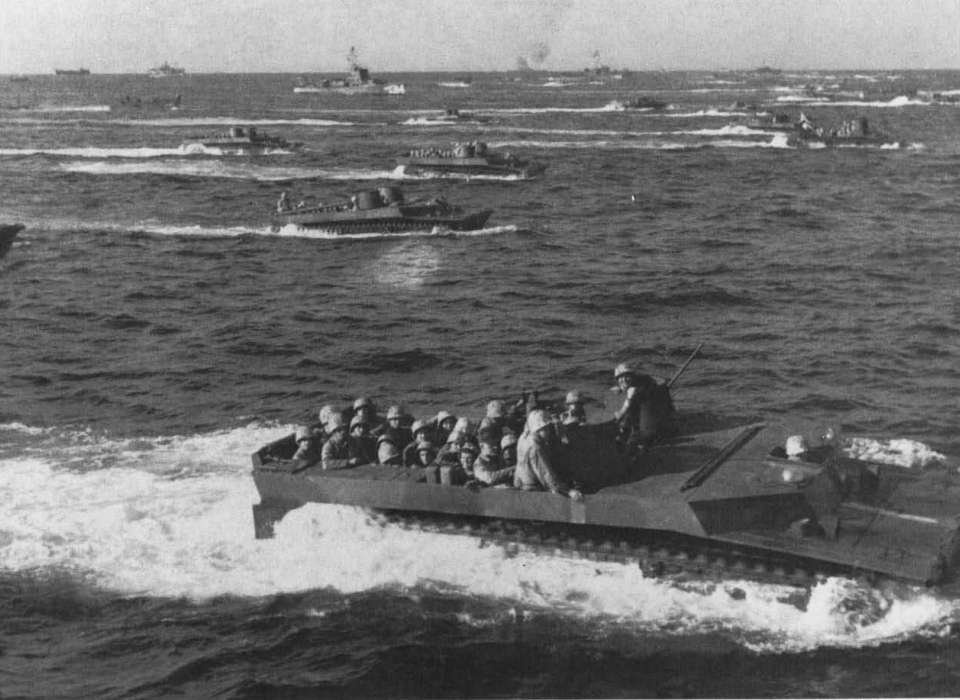
- Amphibious Lift Footprint: Deploying a single J-Series division required precisely 9 Attack Transports (APAs), 3 Attack Cargo Ships (AKAs), and 2 Dock Landing Ships (LSDs).
Post-War Contraction and the BLT Model
Following the Japanese surrender, the U.S. military rapidly demobilized, leaving the Marine Corps severely understrength. To meet the mandates of the National Security Act of 1947, which codified the Corps’ mission to seize and defend advanced naval bases, planners developed the J-Series division.
Instead of maintaining a massive paper force at skeleton-cadre levels, the J-Series eliminated regimental echelons entirely. Divisions were streamlined into 6 organic infantry battalions—though the Corps practically fielded only 9 battalions total, with just 5 stationed in the continental United States.
Reflecting their intended independence as standalone crisis-response forces, these battalions were commanded by full-bird Colonels. Each battalion absorbed the lineages of deactivated WWII regiments, operating structurally as a heavily reinforced Battalion Landing Team (BLT).
Divisional Fires, Armor, and Logistics Slices
The J-Series overhaul aggressively reorganized divisional support assets to plug directly into the BLT framework. Artillery regiments—the 10th Marines and 11th Marines—were downsized to battalion-level commands. They consisted of a Headquarters & Service (H&S) battery, a 4.5-inch rocket battery, and up to 6 batteries of six 105mm howitzers, ensuring one dedicated howitzer battery per BLT.
Heavy armor and combat engineering elements were mathematically sliced to distribute organic combat power to independent battalions. The divisional Tank and Engineer Battalions each fielded two functional companies containing three platoons. This provided an exact ratio of one platoon of 5 tanks and 5 engineers per BLT.
Flame armor was also decentralized, with the Tank Battalion H&S Company retaining two sections of 3 flamethrower tanks to support designated combat teams. To streamline manpower, duplicative support staff from dissolved regimental headquarters were consolidated into an external Service Command, the direct predecessor to the modern Marine Logistics Group (MLG).
The Pivot to K-Series and the Korean War
Despite its innovative approach to decentralized, atomic-era warfare, the J-Series proved to be a fleeting peacetime experiment. By May 1949, the Corps realized that fighting a sustained theater war required traditional regimental mass, prompting the shift to the K-Series Table of Organization.
The peacetime K-Series division authorized 10,232 personnel across two understrength infantry regiments, each holding three battalions. Heavy weapons and anti-tank companies were kept as mobilization cadres.
When the Korean War erupted in 1950, this cadre model struggled under the strain of rapid combat deployment. Early battalions deployed with only two rifle companies, each possessing just two rifle platoons. However, the K-Series allowed for rapid wartime expansion to 22,355 personnel, delivering the combat depth the J-Series inherently lacked.
USMC Divisional Structure Evolution (1945–1950)
| Metric | WWII G-Series (1945) | Peacetime J-Series (1947) | Peacetime K-Series (1949) | Wartime K-Series (1950) |
| Authorized Personnel | 19,176 | 10,569 | 10,232 | 22,355 |
| Infantry Structure | 3 Regiments (9 Battalions) | 0 Regiments (6 Independent Battalions) | 2 Regiments (6 Understrength Battalions) | 3 Regiments (9 Fully Staffed Battalions) |
| Command Echelon | Regimental (Colonel) | Battalion (Colonel) | Regimental (Colonel) | Regimental (Colonel) |
| Artillery Assets | Regimental (multi-battalion) | Battalion-sized (105mm & 4.5″ rockets) | Battalion-based (incl. 155mm howitzers) | Regimental (Fully expanded fire direction) |
| Strategic Focus | Theater-level conventional war | Nuclear-dispersed BLT crisis response | Peacetime cadre for rapid expansion | Protracted theater combat |
Final Assessment
The 1947 J-Series reorganization was a ruthlessly pragmatic adaptation to severe fiscal starvation and the theoretical ambiguities of the nuclear battlefield. By engineering a force capable of projecting modular Battalion Landing Teams without mobilization, the Corps essentially prototyped modern expeditionary warfare and avoided the chaotic lineage destruction seen in the U.S. Army’s later Pentomic structure. However, the J-Series completely lacked the sustainment and mass required for near-peer conventional combat. The 1949 pivot to the K-Series saved the Corps from operational collapse during the outbreak of the Korean War, demonstrating that while highly decentralized BLTs excel at crisis response, surviving high-intensity theater conflict absolutely demands the logistical depth and fire direction of a traditional regimental architecture.