
The United States Navy has officially awarded Boeing a development contract valued at over $20 billion for the full-scale engineering and manufacturing phase of its F/A-XX sixth-generation strike fighter. The decision secures Boeing’s industrial dominance across both current US sixth-generation fighter programs, following its selection for the Air Force’s F-47 air superiority program. The naval variant will share structural and software baselines with its land-based counterpart while featuring heavily reinforced airframes, catapult-launch landing gear, and specialized carrier-handling systems to replace the aging F/A-18E/F Super Hornet fleet.
- Dual-Franchise Consolidation: Boeing secures prime contractor status for both the US Navy’s F/A-XX and the US Air Force’s F-47, locking in major defense aerospace manufacturing scale.
- Contract Valuation: The $20 billion+ initial funding covers full-scale development, systems integration, and multiple flight-test prototypes.
- Operational Range: Delivers an unrefueled combat radius exceeding 1,000 nautical miles (1,150 statute miles / 1,850 km), representing a nearly 50% increase over the F-35C.
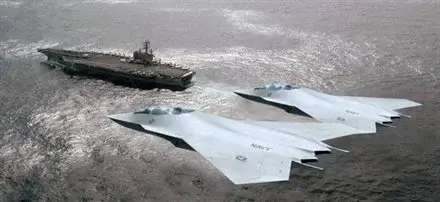
- Broadband Stealth Architecture: Replaces traditional vertical tails and tailplane arrangements with tail-less, integrated inlet designs to minimize detection across both high-frequency targeting and low-frequency early-warning radar bands.
Fleet Modernization and Budget Alignment
The formal award ends extended fiscal friction between executive leadership and naval command over defense acquisition priorities. While administrative delays threatened to defer naval sixth-generation capital funding to support land-based fighter development, congressional intervention ensured the preservation of concurrent naval aviation modernization.
The award funds flight-test airframes, systems integration, and structural validation. Scaling production across both USAF and USN programs expands total orders beyond 800 airframes, creating unprecedented supply chain economies of scale for advanced composites, propulsion, and avionics.
Advanced Low-Observable Mechanics and Extended Radius
The F/A-XX platform shifts away from legacy fifth-generation low-observable design tenets. While platforms like the F-22 Raptor optimized radar cross-section (RCS) reduction against high-frequency X-band threat emitters, sixth-generation architectures prioritize all-aspect broadband stealth. Eliminating vertical tail surfaces reduces planar reflections against lower-frequency L-band and VHF early warning radars.
Crucially, the platform’s 1,000 nautical mile unrefueled combat radius allows US carrier strike groups to operate outside the dense engagement envelopes of anti-ship ballistic missiles and long-range hypersonic glide vehicles deployed by adversary anti-access/area-denial (A2/AD) networks.

Naval Carrier Integration Constraints
Transitioning a land-based air superiority baseline into a carrier-qualified strike platform introduces hard physical constraints. Carrier operations demand higher structural load tolerances to endure high-sink-rate catapult launches and arrested landings. Reinforced landing gear, tailhooks, and folding wing mechanisms increase gross empty weight, requiring specialized flight control software to maintain target speed and range metrics without compromising structural integrity.
| Parameter | F/A-18E/F Super Hornet | F-35C Lightning II | F/A-XX (Boeing) |
| Generation Class | 4.5 Generation | 5th Generation | 6th Generation |
| Primary Stealth Envelope | Conventional / Reduced RCS | Sectoral / High-Frequency | All-Aspect / Broadband |
| Unrefueled Radius | ~470 nautical miles | ~770 nautical miles | >1,000 nautical miles |
| Maximum Velocity | Mach 1.6 | Mach 1.6 | >Mach 2.0 |
| Primary Fleet Role | Multi-Role Carrier Strike | Multi-Role Stealth Strike | Air Dominance & Carrier Strike |
FINAL ASSESSMENT: Boeing’s selection for the F/A-XX program restores the long-range offensive striking capability of the carrier air wing. By extending the unrefueled reach of carrier strike groups to over 1,000 nautical miles while incorporating broadband low-observable features, the Navy establishes an essential operational balance against advanced A2/AD systems, securing carrier relevance into the late 2030s and beyond.