KEY INTELLIGENCE
- Prototype Deliveries On-Track: GDLS delivered its first “Wolf” prototype on August 21, followed by American Rheinmetall’s “Lynx30” on September 1; each vendor will supply eight vehicles for comprehensive operational field evaluations.
- Next-Gen Lethality Standard: Both platforms integrate the government-preferred XM913 50mm automatic cannon mounted on high-elevation unmanned turrets to defeat light armor and fulfill Counter-Unmanned Aerial Systems (C-UAS) duties.
- Cognitive Load Constraints: The XM30 mandate reduces traditional vehicle crew requirements from three to two soldiers (plus six dismounts), relying heavily on AI-driven target tracking, 360-degree electro-optical situational awareness, and automated sensor fusion.
- Integrated Loitering Munitions: Defense vendors are embedding organic strike drones into launch platforms: Rheinmetall pitches the Raytheon multi-mission launcher (Coyote UAS / TOW / Javelin), while GDLS incorporates AeroVironment’s Switchblade 300.
- Programmatic Red Flags: Despite advancing further than previous replacement concepts, the Army’s refusal to sign Milestone B documents in mid-2025 and a February 2026 RFI for alternative 40–80 ton tracked platforms highlight persistent institutional cold feet.
The XM30 Mandate: Overcoming the Legacy of Failed Replacements
The XM30 Mechanized Infantry Combat Vehicle program represents the direct evolutionary product of the Optionally Manned Fighting Vehicle (OMFV) initiative launched in 2018. Designed to overcome the physical limits of space, weight, and power (SWaP) inherent to the four-decade-old M2 Bradley hull, the Army’s XM30 Request for Proposals (RFP) centers on four primary operational pillars: tactical survivability, high-power mobility, advanced lethality, and reduced crew size.
Central to the Army’s technical requirements is a Modular Open Systems Architecture (MOSA). By enforcing a government-defined electronic and hardware framework, the Army aims to integrate novel sensors, software iterations, and directed-energy counter-UAS platforms without vendor lock-in. Furthermore, the XM30 is built from inception to operate alongside Unmanned Ground Vehicles (UGVs) and launch organic loitering munitions to defeat mechanized targets beyond line-of-sight.
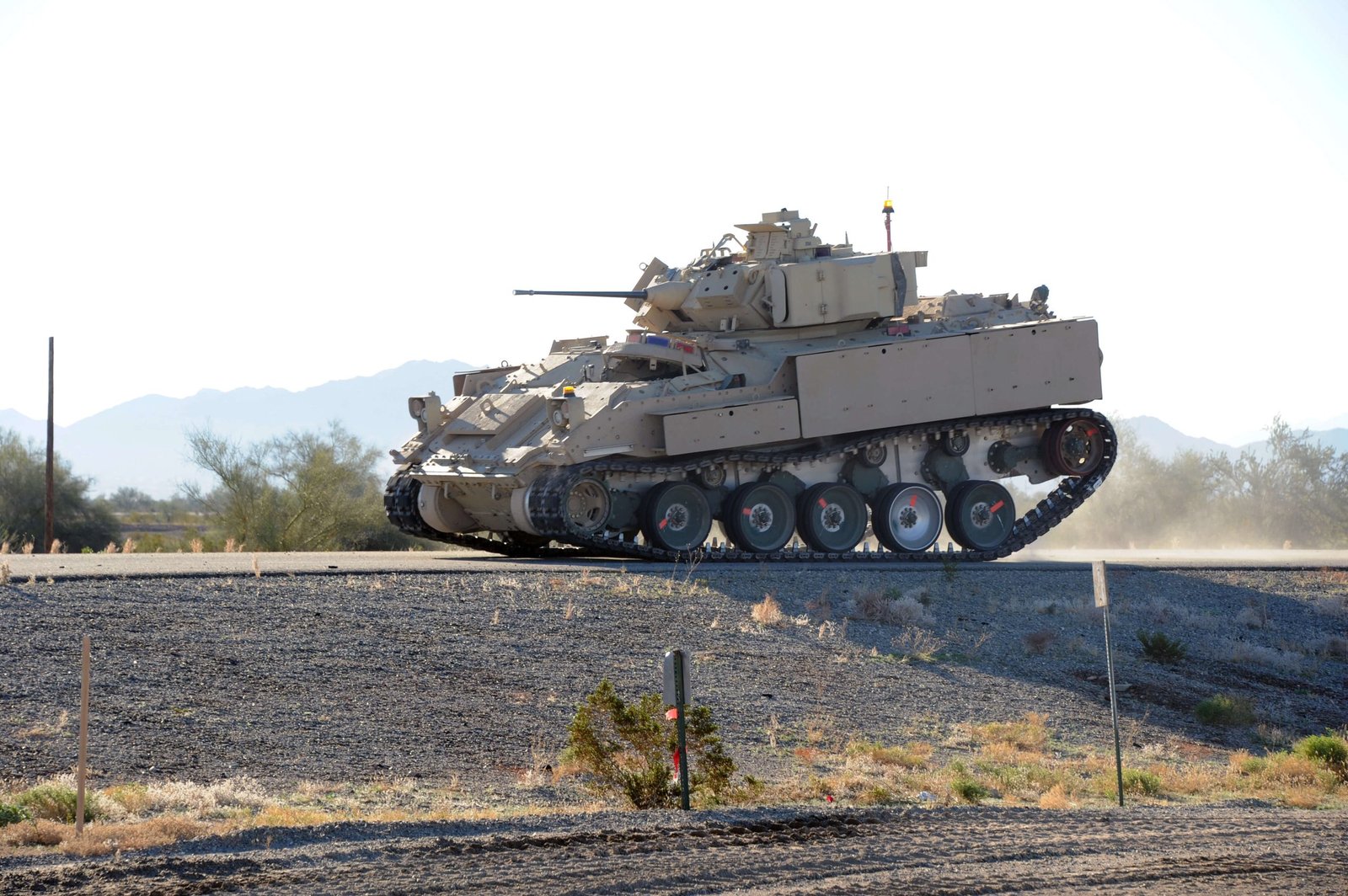
American Rheinmetall Lynx vs. GDLS Wolf
American Rheinmetall Lynx30
Rheinmetall’s offering leverages the baseline KF41 IFV chassis but features an extensive Americanization overhaul executed alongside U.S. defense partners Raytheon, L3Harris, Allison Transmission, Textron Systems, and Anduril.
- Turret & Ordnance: Operates a Lance 5030 unmanned turret housing the XM913 50mm automatic cannon.
- Propulsion: Utilizes the Allison EG Force hybrid-electric transmission, providing thermal/acoustic silent maneuver capability alongside massive electrical power generation for active protection systems (APS).
- Secondary Armament: Integrates a Raytheon multi-mission launcher capable of deploying TOW anti-tank guided missiles, Javelin ATGMs, or Coyote loitering munitions.
- Crew/Dismount Capacity: Configured for two vehicle operators and six fully equipped infantry dismounts.
General Dynamics Land Systems Wolf
GDLS has maintained strict operational security surrounding the Wolf XM30, developing the armored vehicle as a clean-sheet design rather than a direct derivative of its prior Griffin III demonstrator.
- Digital Engineering: Marketed as “born digital,” the platform maintains an exact digital twin, enabling the Army to model modifications, stress limits, and SWaP-C metrics prior to physical production.
- Firepower & Architecture: Features an unmanned turret carrying the XM913 50mm cannon, fully compliant with MOSA standards for plug-and-play electronic warfare and sensor suites.
- Propulsion & Drivetrain: Powered by an advanced hybrid-electric drivetrain engineered to support high-draw sensor suites, active protection systems, and high-kilowatt defense hardware.
- Unmanned Systems Integration: Outfitted with an integrated launcher for AeroVironment Switchblade 300 loitering munitions to extend organic precision strike capabilities.
While the delivery of 16 combined prototypes marks the furthest any Bradley replacement program has progressed, structural skepticism remains widespread across the defense acquisition landscape. The U.S. Army possesses a troubled track record when attempting to modernize its armored fleet, having expended vast fiscal resources on canceled modernization efforts.
Institutional hesitation surfaced in June 2025 when Army leadership declined to sign off on Milestone B approval for the XM30, delaying the formal program baseline. Pressure increased further in February 2026, when the service issued an industry-wide Request for Information (RFI) seeking designs for a 40–80 ton tracked combat vehicle with potential production rates reaching 2,500 units annually.
While Army acquisition executives maintain that the RFI merely enforces cost control and schedule discipline on GDLS and Rheinmetall, the move provides a clear strategic off-ramp should soldier touchpoints with the 1st Cavalry Division expose operational vulnerabilities in early 2027.
| Technical Parameter | M2A4 Bradley IFV (Legacy) | American Rheinmetall Lynx30 | GDLS Wolf XM30 |
| Operating Crew Size | 3 (Commander, Gunner, Driver) | 2 (Commander/Gunner, Driver) | 2 (Commander/Gunner, Driver) |
| Dismount Troop Capacity | 6–7 Dismounts | 6 Dismounts | 6 Dismounts |
| Primary Armament | 25mm M242 Bushmaster Chain Gun | 50mm XM913 Automatic Cannon | 50mm XM913 Automatic Cannon |
| Turret Configuration | Manned Dual-Feed Turret | Unmanned Lance 5030 Turret | Unmanned High-Elevation Turret |
| Organic Strike Drones | None (Field Modifications Only) | Raytheon Launcher (Coyote UAS) | AeroVironment Switchblade 300 |
| Propulsion Architecture | Conventional Diesel (Cummins VTA-903T) | Allison EG Force Hybrid-Electric | Clean-Sheet Hybrid-Electric Drive |
| Silent Maneuver Mode | Unavailable | Integrated (Battery Powered) | Integrated (Battery Powered) |
| System Architecture | Proprietary Legacy Harness | Modular Open Systems (MOSA) | “Born Digital” / Open MOSA |
The XM30 program represents a true force multiplier on paper, offering unmatched standoff lethality via its 50mm main gun, hybrid-electric power generation, and seamless integration with organic loitering munitions. However, reducing the vehicle crew to two personnel places severe reliance on automated target acquisition systems in high-intensity electronic warfare environments.
Given the Army’s failure to sign Milestone B documentation, its February 2026 multi-ton alternative RFI, and recent precedent set by high-profile armor cancellations, the procurement risk for XM30 remains high. Unless field testing with the 1st Cavalry Division yields a flawless operational outcome prior to the scheduled Spring 2027 source selection, defense professionals should expect the Army to issue further life-extension overhauls to the legacy M2A4 Bradley platform while shifting capital toward unmanned ground vehicles (UGVs).