Bottom Line Up Front
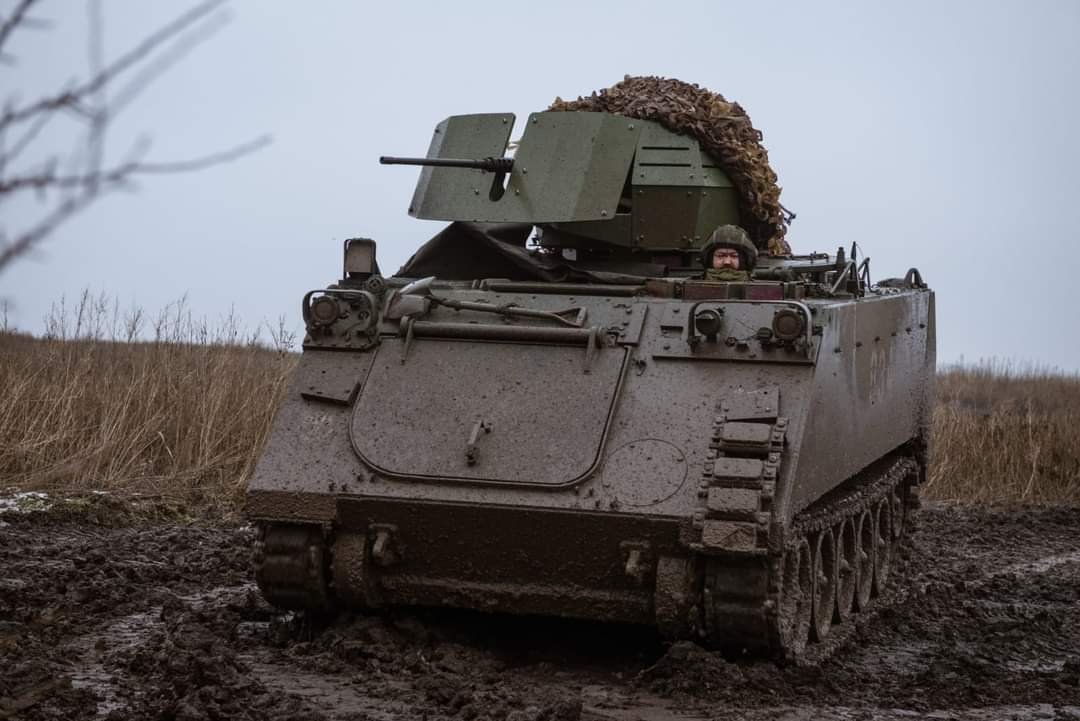
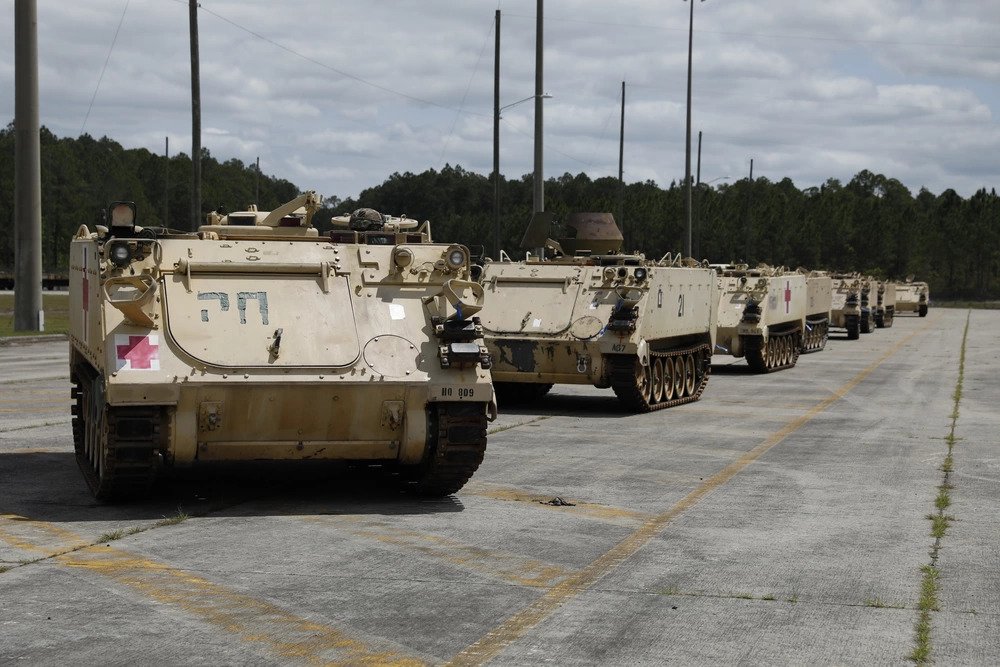
- The Platform: U.S.-designed M113 APC, chosen for its abundance (1,700+ donated to Ukraine) and mechanical simplicity. The lack of complex digital architecture allows for straightforward drive-by-wire automation using servos and actuators.
- The Payload: A heavy front-mounted flail system capable of detonating pressure-fuzed mines. Small battery-powered UGVs lack the torque, weight, and endurance to push heavy mechanical breaching equipment; a 12-ton diesel tracked vehicle provides the necessary kinetic power.
- Defensive Modifications: A dual-layer anti-drone suite featuring standard slat/mesh cage armor, supplemented by a “hedgehog-style” spiked frame designed to snag or prematurely detonate incoming FPV drones before hull impact.
- The Strategic Driver: Ukraine faces up to 128,000 square kilometers of mined territory with only roughly 4,500 trained sappers. The robotic M113 preserves irreplaceable human combat engineers by transferring the risk to a heavily attrited, expendable legacy platform.
The Khartiia Retrofit: Automating a Cold War Relic
The 13th Brigade of Ukraine’s National Guard is not experimenting for the sake of public relations. By December 2024, Khartiia had already executed an uncrewed combined-arms assault north of Kharkiv, synchronizing aerial drones, mine-laying UAVs, and armed ground robots to clear a Russian trench line without exposing a single infantryman. Their robotic M113 is an evolution of this unmanned doctrine, scaled up to handle heavy combat engineering.
The conversion relies on the M113’s mechanical baseline. Powered by a diesel engine and steered by mechanical levers rather than a computerized fire-control network, the APC is easily retrofitted. Brigade workshops bypass multi-year procurement cycles by simply adding actuators to the pedals and levers, linking them to an onboard control box.
A secure radio link feeds inputs from a remote operator positioned safely behind the tree line, while a network of low-mounted hull cameras provides the situational awareness and depth perception required to navigate craters, ditches, and mud. Crucially, the system features a hardwired emergency kill switch—preventing a 12-ton rogue tracked vehicle from rolling into friendly lines if the EW environment severs the control link.
Surviving the FPV Kill Zone
A mine-clearing vehicle is the ultimate target for an FPV drone operator. It is massive, incredibly loud, moves at a walking pace, and must follow a predictable linear path. During the 2023 counteroffensive, Ukraine lost roughly half of its specialized, manned Leopard 2R breaching vehicles almost immediately upon entering the breach.
To adapt, the unmanned M113 is draped in standard welded steel cage armor to enforce standoff detonations against shaped charges. More uniquely, Khartiia added an outward-projecting spiked frame—a hedgehog structure designed to physically entangle drones before their contact fuzes can trigger against vulnerable surfaces.
Because the original 1960s M113 aluminum hull was only designed to stop heavy machine-gun fire, it routinely fails against modern anti-tank mines and FPVs (open-source trackers count over 650 lost or damaged in Ukraine). Removing the human crew nullifies this critical flaw. A drone strike on an unmanned M113 is reduced from a mass-casualty event to a localized maintenance problem.
The Arithmetic of Attrition: Solving the Sapper Shortage
The tactical ingenuity of the robotic M113 serves a grim strategic reality. By mid-2026, an estimated 128,000 square kilometers of Ukrainian territory were contaminated by landmines, representing a $28 billion clearance challenge.
Ukraine’s binding operational constraint is its lack of combat engineers. With slightly more than 4,500 trained sappers tasked with clearing an area the size of a European country, human attrition is unsustainable. A competent sapper requires months of training, technical nerve, and accumulated pattern recognition. Conversely, Ukraine has hundreds of M113 hulls in various states of repair. By shifting the breaching burden from an irreplaceable human to an abundant, obsolete machine, Ukraine changes the math of the attrition war.
Dual-Use Logistics and Electronic Warfare Variables
While equipped as a combat breacher, the robotic M113 simultaneously functions as a heavy logistics platform. Footage released by Khartiia shows the vehicle delivering supplies to forward infantry positions. This consolidates two high-risk support missions—route clearance and frontline resupply—into a single autonomous run, navigating the 35-to-100-kilometer drone kill zones that currently blanket the front.
The primary operational unknown remains the control link’s resilience against Russian electronic warfare. The brigade has heavily guarded the system’s technical specifications. Whether it relies on frequency-hopping radios, mesh relay networks, or satellite links will dictate whether this platform can operate at scale in the most contested EW environment in modern history.
Strategic Assessment
Tactical Verdict: Unmanned ground vehicles (UGVs) weighing a few hundred kilograms lack the brute physics to push mechanical mine flails. By automating a 12-ton M113, Khartiia Brigade combines the expendability of a drone with the torque of a heavy combat engineering vehicle. Operating without a crew negates the catastrophic vulnerability of the M113’s thin aluminum armor, transforming guaranteed casualties into acceptable material losses during slow, highly exposed breaching operations.
Strategic Verdict: Ukraine is successfully weaponizing its legacy inventory. Instead of waiting on multi-year, nine-figure NATO procurement cycles for purpose-built robotic armor, Kyiv is using basic garage engineering—cameras, servos, and radios—to solve its most acute manpower shortage. This retrofit pipeline preserves irreplaceable combat sappers and offers a direct blueprint for Western militaries looking to recycle thousands of obsolete, aging armored hulls into autonomous vanguard fleets.