KEY INTELLIGENCE: BOEING F-47 NGAD PROGRAM
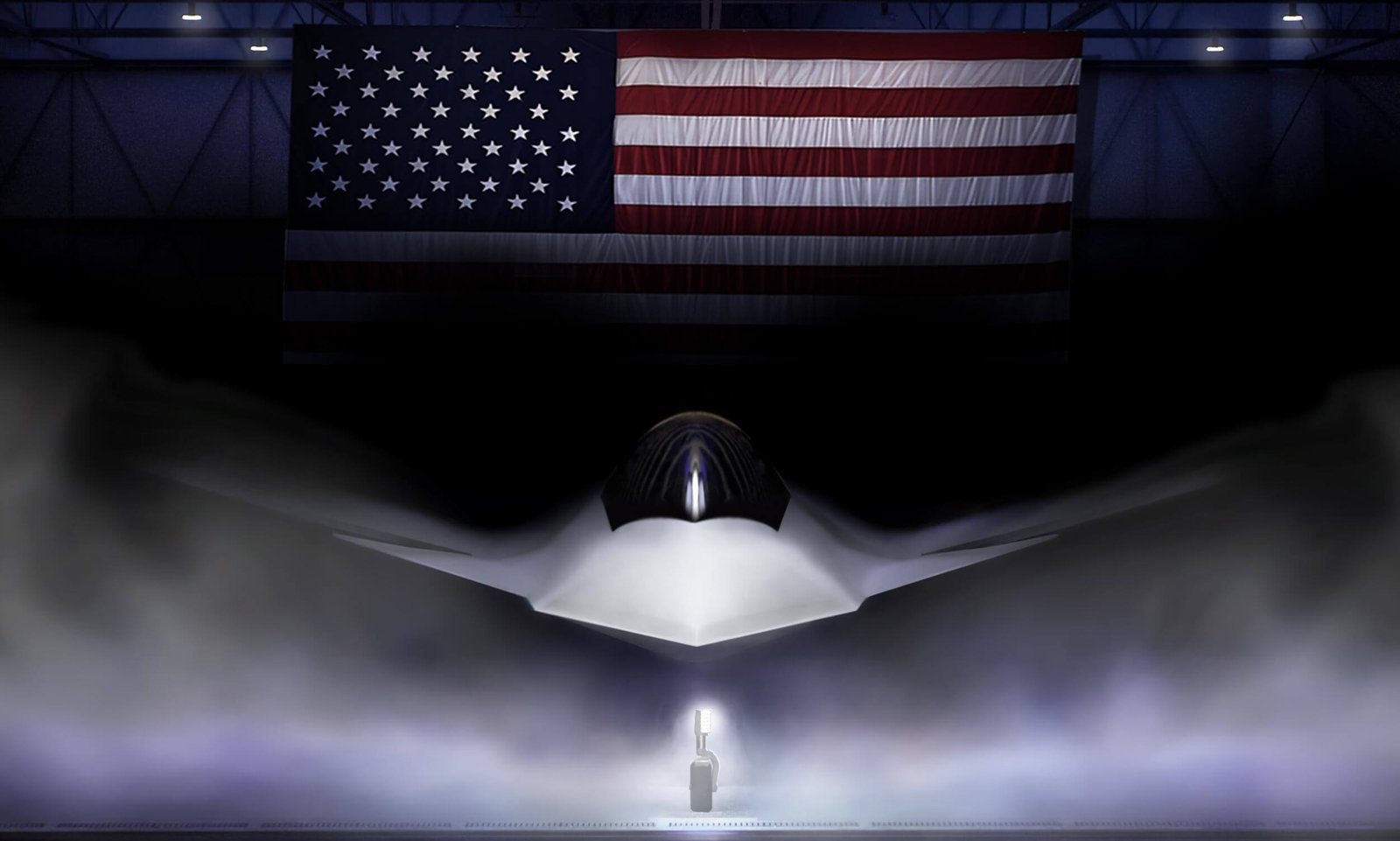
- Contract Award: In March 2025, Boeing secured the $20 billion Engineering and Manufacturing Development contract to build the F-47, the world’s first sixth-generation air superiority fighter.
- Indo-Pacific Range: The F-47 boasts a combat radius exceeding 1,000 nautical miles (approx. 1,850 km)—nearly double that of the F-22—allowing it to strike targets from Guam or Japan with drastically reduced tanker dependence.
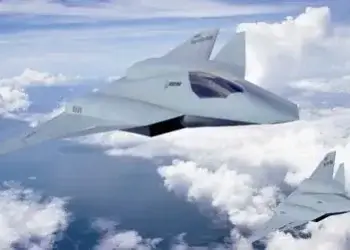
- Design Architecture: Operating tailless for “bomber-like” broadband stealth, the F-47 embeds deep internal weapon bays and next-generation adaptive cycle engines optimized for thermal management.
- Collaborative Combat Aircraft (CCA): The F-47 is not a lone dogfighter; it operates as a flying command node controlling networks of autonomous drone wingmen that act as forward sensors, missile carriers, and electronic decoys.
- Timeline: Experimental X-plane prototypes have been flying since 2020. The official first flight is slated for 2028, with the Air Force targeting a fleet of at least 185 jets operating in the 2030s.
The Geography of Denial: Why 5th Generation is Outranged
The F-22 and F-35 were designed for an era where the U.S. operated from forward bases relatively close to the combat zone. In a potential conflict over Taiwan or the South China Sea, those forward bases in Japan, South Korea, and the Philippines fall deep within the engagement envelope of China’s ballistic and cruise missiles.
Operating from safer distances, such as Andersen Air Force Base in Guam, presents a severe distance problem. The F-22 has an unrefueled combat radius of roughly 590 nautical miles. Reaching the Taiwan Strait from Guam requires a round trip of over 3,000 miles, mandating multiple mid-air refuelings. China’s long-range air-to-air missiles and advanced stealth fighters (like the J-20 and J-35) are explicitly designed to bypass U.S. fighters and destroy the slow, unstealthy KC-135 and KC-46 refueling tankers. If the tankers go down, the U.S. stealth fleet runs out of fuel over the Pacific.
The Boeing F-47: The Sixth-Generation Solution
To outrange the Chinese A2/AD bubble, the Air Force paused the NGAD program in late 2024 to reevaluate costs, ultimately awarding the contract to Boeing in March 2025 for the newly designated F-47.
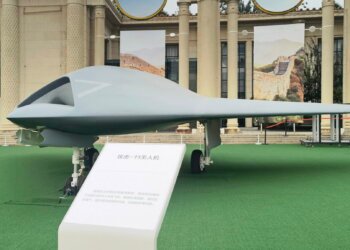
The F-47 discards the traditional vertical stabilizer (tail) seen on all previous fighter jets. This “flying wing” or blended wing-body design delivers “all-aspect, broadband low-observability,” drastically reducing its radar and infrared signature from every angle, not just the front.
While a tailless design inherently reduces dogfighting maneuverability, the NGAD philosophy assumes that within-visual-range dogfighting is largely obsolete. Instead, the F-47 relies on advanced sensor fusion, flying at Mach 2+, and deploying long-range munitions like the AIM-260 Joint Advanced Tactical Missile from fully enclosed weapon bays. By pushing the combat radius beyond 1,000 nautical miles, the F-47 can penetrate contested airspace while keeping highly vulnerable tanker aircraft safely out of range of enemy interceptors.
The Drone Multiplier: Collaborative Combat Aircraft
The defining leap in sixth-generation warfare is the shift from manned dogfighters to autonomous networks. The F-47 is engineered to fly alongside Collaborative Combat Aircraft (CCAs)—highly capable, AI-driven drones commonly referred to as “loyal wingmen”.
The human pilot in the F-47 acts as a quarterback or mission commander. Instead of exposing the $100+ million manned aircraft to active surface-to-air missile (SAM) radar locks, the F-47 directs CCAs miles ahead into the danger zone.
These autonomous drones serve distinct roles:
- Sensor Nodes: Flying forward to actively ping radar and locate stealth targets, feeding data back to the radio-silent F-47.
- Weapon Trucks: Carrying additional air-to-air missiles, effectively multiplying the payload capacity of the formation.
- Attritable Decoys: Deliberately exposing themselves to enemy fire, forcing adversaries to waste multi-million dollar interceptors on cheaper unmanned airframes.
This radically alters the economics of air combat, creating overwhelming mass that adversary air defenses cannot efficiently track or destroy.
Key insight: The true value of the F-47 isn’t its top speed or individual stealth—it’s the ability to act as a stealthy command center that projects drone firepower deep into enemy territory while remaining undetected.
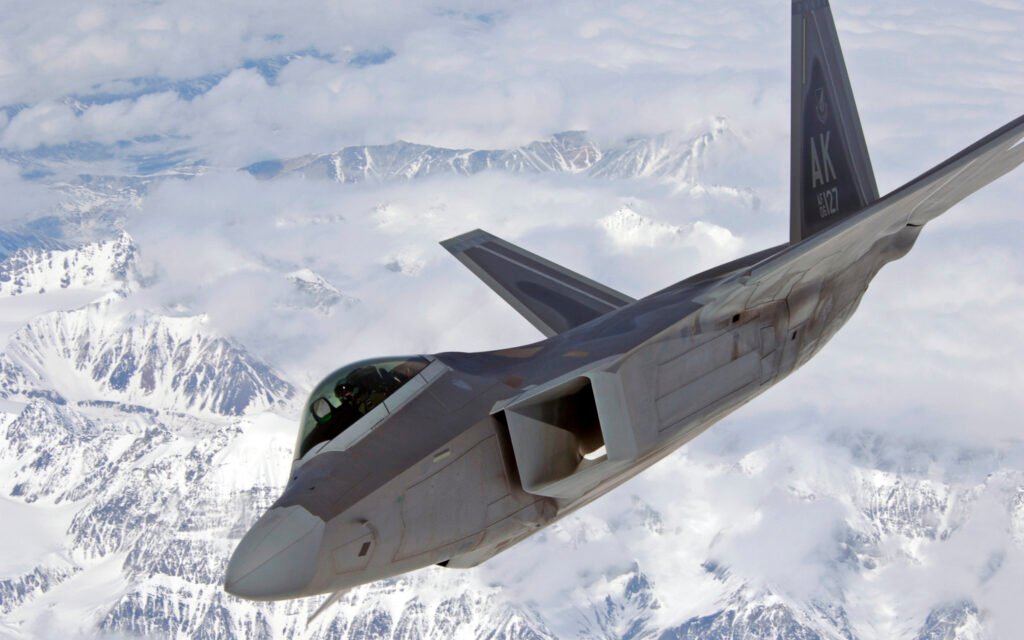
Generational Shift: F-22 Raptor vs. F-47 NGAD
| Metric | 5th Gen: Lockheed F-22 Raptor | 6th Gen: Boeing F-47 NGAD | Strategic Impact for Indo-Pacific |
| First Flight | 1997 | Expected 2028 | Generational leap in computing, AI, and material science. |
| Combat Radius | ~590 Nautical Miles | 1,000+ Nautical Miles | Allows operations from Guam without immediate tanker support. |
| Top Speed | Mach 2.25 | Mach 2+ | Sustained supercruise for rapid threat response over vast oceans. |
| Stealth Profile | Narrowband (Optimized for X-band) | Broadband / All-Aspect | Tailless design defeats low-frequency early warning radars. |
| Force Structure | Manned Dogfighter | Manned Command Node | Pilot manages autonomous CCA drones instead of flying solo. |
| Target Unit Cost | ~$143 Million | Unknown (Expected < F-22) | Focuses capital on cheaper, mass-produced CCA drones. |
STRATEGIC VERDICT
The U.S. Air Force’s pivot to the Boeing F-47 NGAD acknowledges a harsh reality: stealth and speed are irrelevant if an aircraft cannot physically reach the battlefield. By prioritizing extreme range, broadband thermal/radar stealth, and autonomous CCA integration over traditional dogfighting maneuverability, the Pentagon is building an air force designed explicitly to crack China’s A2/AD networks. The F-47 is not just a replacement for the F-22; it is a fundamental redefinition of air combat, shifting the burden of risk from human pilots to attritable machines and pushing U.S. power projection beyond the reach of adversary missiles.