Frontline Defense Journal | Objective OSINT & Military Analysis
  • Home
  • Latest Intelligence
  • Domain Of Warfare
    • Naval & Maritime
    • Air & Aerospace
    • Ground Forces & Armor
    • Space & Cyber
    • Unmanned & Autonomous Systems
    • Strategic Weapons
  • Regions
    • USA & Americas
    • Europe
    • Middle East
    • Asia & Pacific
  • About Us
    • Who We Are
    • Privacy Policy
    • Terms Of Use
No Result
View All Result
  • Home
  • Latest Intelligence
  • Domain Of Warfare
    • Naval & Maritime
    • Air & Aerospace
    • Ground Forces & Armor
    • Space & Cyber
    • Unmanned & Autonomous Systems
    • Strategic Weapons
  • Regions
    • USA & Americas
    • Europe
    • Middle East
    • Asia & Pacific
  • About Us
    • Who We Are
    • Privacy Policy
    • Terms Of Use
Frontline Defense Journal | Objective OSINT & Military Analysis
No Result
View All Result
Frontline Defense Journal | Objective OSINT & Military Analysis
No Result
View All Result
Home Domain Of Warfare Air & Aerospace

US Targets Iran’s Pickaxe Mountain With GBU-57 Bunker Buster

The United States has designated Iran’s subterranean "Pickaxe Mountain" (Kuh-e Kolang Gaz La) near Natanz as a primary kinetic target amidst escalating maritime hostilities in the Strait of Hormuz. Buried over 100 meters beneath a 1,600-meter peak, the facility is engineered to withstand conventional aerial bombardment. The Pentagon is signaling the potential deployment of the 13,600-kilogram GBU-57 Massive Ordnance Penetrator (MOP) to neutralize the site before centrifuge assembly becomes fully operational.

August 29, 2026
in Air & Aerospace, Domain Of Warfare, Latest Intelligence, Middle East
Reading Time: 5 mins read
A A
0
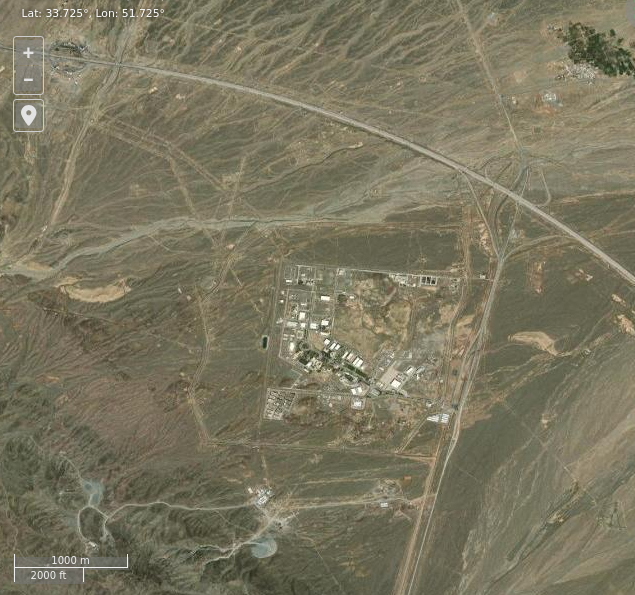
Satellite imagery of the Natanz Nuclear Facility
Share on FacebookShare On Reddit

Stratigic Summary

Target Depth: Pickaxe Mountain is buried at least 100 meters (328 feet) underground, making it Iran’s deepest nuclear-related facility to date.

Primary Weapon: The GBU-57A/B MOP weighs 13,600 kg (30,000 lbs) and delivers a 2,423 kg (5,342 lb) AFX-757/PBXN-114 explosive payload.

Penetration Deficit: The MOP penetrates a maximum of 61 meters (200 feet) of earth/rock or 18 meters (60 feet) of 5,000 psi concrete—falling short of the facility’s main depth in a single strike.

Strategic Catalyst: Iranian proxy attacks and naval mine detonations on merchant shipping in the Strait of Hormuz and Caspian Sea are accelerating U.S. strike timelines.

Iran has dramatically increased asymmetric naval operations, heavily mining the Strait of Hormuz and initiating proxy engagements against merchant shipping in the Red and Caspian Seas. This maritime blockade attempts to leverage global oil transit to fracture U.S. economic pressure.

In direct response, the U.S. has placed Pickaxe Mountain (Kuh-e Kolang Gaz La) squarely in its crosshairs. Located just 2 kilometers south of the Natanz nuclear complex, this sprawling 2.7-square-kilometer underground facility was initiated in 2020 following severe sabotage at above-ground Natanz centrifuge sites.
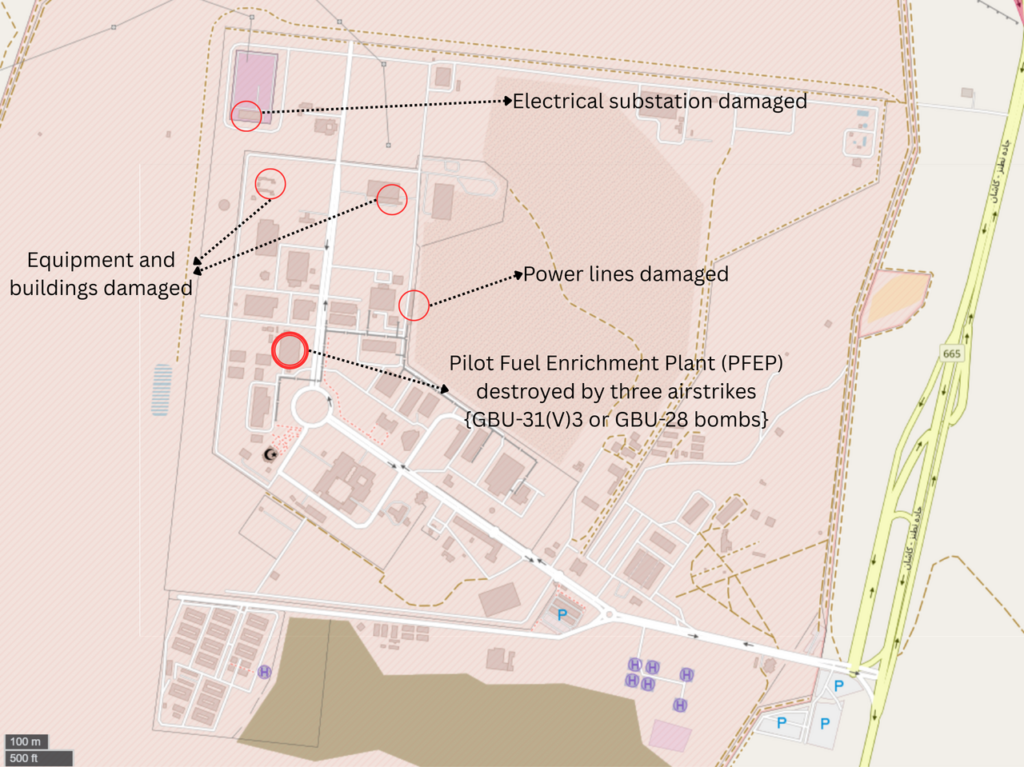
Israeli Airstrikes on the Natanz Nuclear Facility during Operation Rising Lion
Israeli Airstrikes on the Natanz Nuclear Facility during Operation Rising Lion. Source: Wikipedia Commons

Technical Breakdown: The GBU-57 MOP vs. Deep Earth Hardening

To neutralize a facility buried 100 meters deep, conventional munitions are entirely ineffective. The U.S. must deploy the GBU-57 Massive Ordnance Penetrator (MOP), delivered exclusively by B-2 Spirit or B-21 Raider stealth bombers.

The MOP utilizes a specialized steel alloy casing and an integrated GPS/INS guidance package to drill through earth and rock. The weapon relies on extreme ground-shock coupling mechanics before the LPSF (Large Penetrator Smart Fuze) detonates the warhead at the optimal subterranean depth. However, the MOP’s maximum known penetration is 61 meters (200 feet) through earth, leaving a critical 40-meter deficit to the primary centrifuge halls.

Operational Impact: Ground-Shock Coupling and Repeat Strike Tactics

Because a single MOP cannot reach the subterranean centrifuge halls, U.S. operational planners must rely on “drilling” tactics. This requires dropping multiple MOPs with a Circular Error Probable (CEP) of just a few meters into the exact same crater to compound the penetration depth and maximize the kinetic shock effects on the deep tunnel structures.

Alternatively, planners may target the facility’s vulnerable surface infrastructure. By collapsing the two pairs of above-ground tunnel portals, severing external power supply lines, and collapsing ventilation shafts using smaller 907-kilogram (2,000 lb) bunker busters, the U.S. can entomb the facility.

Geopolitical Outlook: Escalation Matrix

While satellite intelligence indicates Pickaxe Mountain is not yet actively enriching uranium, the massive capital expenditure proves Iran’s intent to secure an indestructible nuclear supply chain.

A U.S. kinetic strike sends an unambiguous message: geographical and geological hardening cannot guarantee the survival of Iranian nuclear assets. The escalation matrix now hinges on whether Iran maintains its maritime blockade or capitulates to preserve its subterranean investments.

MetricPickaxe Mountain (Kuh-e Kolang Gaz La)GBU-57A/B Massive Ordnance Penetrator
Primary CompositionDeep subterranean rock, reinforced concreteSpecialized high-strength steel alloy casing
Depth / Penetration>100 meters (328 ft) below surfaceMax 61 meters (200 ft) (earth/rock)
Concrete ResistanceUnknown, potentially >30,000 psi domestic concretePenetrates 18 meters (60 ft) of 5,000 psi concrete
Total Area / Weight2.7 square kilometers (surface footprint)13,600 kg (30,000 lbs)
Tactical ProfileVulnerable egress portals, power grid dependenceRequires repeat precision strikes; B-2/B-21 dependency

TACTICAL VERDICT

Pickaxe Mountain represents a structural vulnerability paradox. While its 100-meter depth theoretically protects the primary enrichment halls from a single GBU-57 MOP strike, its reliance on surface-level infrastructure creates critical single points of failure. The U.S. does not need to physically breach the subterranean centrifuge halls to achieve strategic victory; collapsing the egress portals and destroying the ventilation systems will neutralize it as an operational asset, effectively burying it alive.

Tags: osintstrait of hormuzus iran war

Related Posts

The F-16CJ Viper serves as the primary platform for CENTCOM's Suppression of Enemy Air Defenses (SEAD) campaign, systematically dismantling IRGC radar networks.
Air & Aerospace

US SEAD Strikes Dismantle IRGC Network in Strait of Hormuz

September 3, 2026
A B-2 Spirit stealth bomber flying with GBU-57 MOP explosions detonating across a desert landscape below.
Middle East

IRGC Desperation & US Deterrence: Inside B-2/F-35 Strike Options

September 2, 2026
A photo of Iranian warship Shahid Bagheri during US strikes.
Naval & Maritime

Iran’s “Aircraft Carrier” Illusion: The Truth Behind the Shahid Bagheri

September 1, 2026
Next Post

Ukraine MiG-29 Standoff Strike Halts Russian Sumy Offensive

Leave a Reply Cancel reply

Your email address will not be published. Required fields are marked *

I agree to the Terms & Conditions and Privacy Policy.

Latest Intelligence

Irreplaceable Russian Tu-95 Bomber Destroyed by $48K Ukrainian “MICH 2000”

Kinburn Spit Death Trap: Ukraine Traps 2,500 Russian Troops in Logistical Siege

US SEAD Strikes Dismantle IRGC Network in Strait of Hormuz

CIA Director Warns FSB: Putin’s Fabricated Intel Risks Total Russian Collapse

USS Abraham Lincoln Docks in Thailand After 286-Day Combat Deployment Amid “Rust” Disinformation

Canada’s Secret CDPSC Program: The Pivot to Cheap Deep Strike Mass

Middle East

A Russian Tu-95 strategic bomber in flight, showcasing its swept wings and four turboprop engines.
Air & Aerospace

Irreplaceable Russian Tu-95 Bomber Destroyed by $48K Ukrainian “MICH 2000”

Tactical map showing the Kinburn Spit, Mykolaiv Oblast, and the Dnipro River Delta in southern Ukraine.
Ground Forces & Armor

Kinburn Spit Death Trap: Ukraine Traps 2,500 Russian Troops in Logistical Siege

Frontline Defense is an independent, objective analysis platform. The content provided on this website, including but not limited to technical breakdowns, military hardware comparisons, defense budget reports, and open-source intelligence (OSINT) analyses, is strictly for educational, historical, and informational purposes. Frontline Defense is not affiliated with, endorsed by, or acting on behalf of any government agency, department of defense, armed forces branch, or defense contractor. All content on this site represents independent research based strictly on unclassified, publicly available data and open-source records at the time of writing. Nothing published on this website should be construed as official military guidance, defense strategy consulting, or government policy.

Follow Us

Domain Of Warfare

  • Naval & Maritime
  • Air & Aerospace
  • Ground Forces & Armor
  • Space & Cyber
  • Strategic Weapons
  • Unmanned & Autonomous Systems

Regions

  • USA & Americas
  • Europe
  • Middle East
  • Asia & Pacific
  • About Us
  • Privacy Policy
  • Terms Of Use

© 2026 | Fronline Defense Journal. All Rights Reserved

No Result
View All Result
  • Home
  • Latest Intelligence
  • Domain Of Warfare
    • Naval & Maritime
    • Air & Aerospace
    • Ground Forces & Armor
    • Space & Cyber
    • Unmanned & Autonomous Systems
    • Strategic Weapons
  • Regions
    • USA & Americas
    • Europe
    • Middle East
    • Asia & Pacific
  • About Us
    • Who We Are
    • Privacy Policy
    • Terms Of Use

© 2026 | Fronline Defense Journal. All Rights Reserved