STRATEGIC SUMMARY
- Strategic Reality: The Shahid Bagheri was fundamentally a propaganda asset, not a peer-level aircraft carrier. Converted from a commercial hull, it lacked the defensive architecture, hangar space, and structural integrity required for modern naval aviation.
- Capability Deficit: The vessel’s elevators and flight deck could only support lightweight drones and a handful of helicopters. Operating standard one-way attack drones (like the Shahed-136) from ground launchers remains infinitely more efficient than deploying them from an unprotected ship.
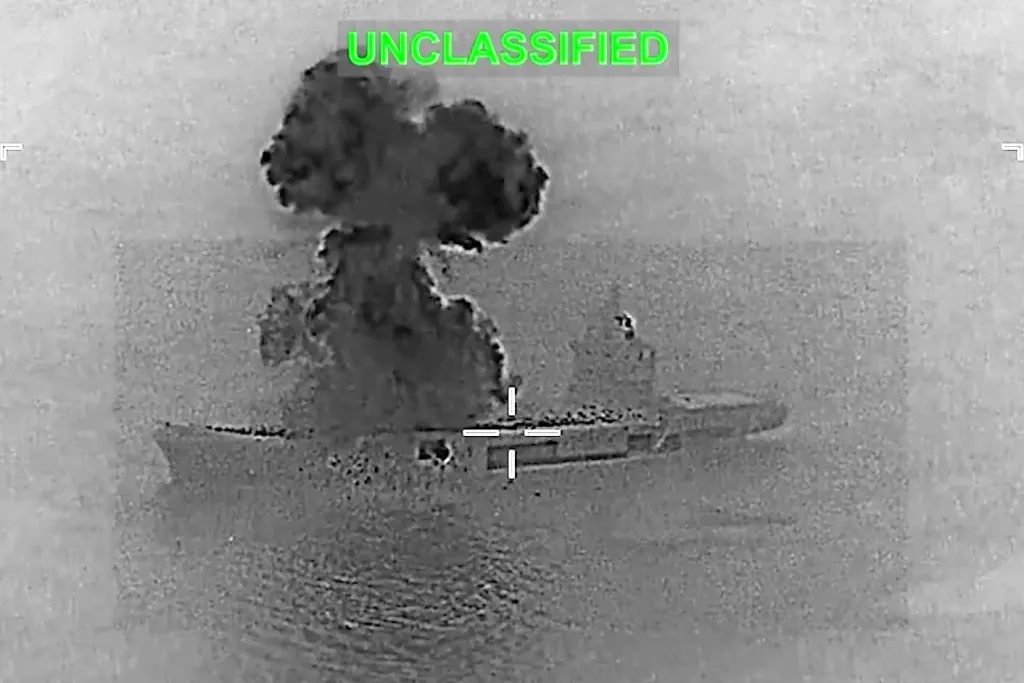
- Combat Neutralization: Just three days into the recent conflict, U.S. forces struck the ship twice—once on the flight deck and once near its anti-ship missile launchers. It was completely disabled and currently sits stranded in the shallow waters of the Clarence Strait.
- Asymmetric Advantage: The destruction of the Shahid Bagheri highlights that Iran’s real naval strength is asymmetric: underground ballistic missile bases, naval mines, and swarms of fast-attack craft, not pseudo-carriers.
The Anatomy of a Pseudo-Carrier
Historically, Iran has experimented with carrier mock-ups, often building them purely to destroy them in highly publicized military exercises. The Shahid Bagheri, however, was their most ambitious attempt at creating a functional aviation vessel.
Converted from an aging commercial container ship between 2022 and mid-2024, the Islamic Revolutionary Guard Corps (IRGC) Navy grafted on features characteristic of real carriers. It featured an angled runway, a ski-jump ramp (common on British and Russian carriers), arresting gear, and an elevator. Iran claimed the ship had a range of over 40,000 kilometers, theoretically granting them a “blue-water” footprint.
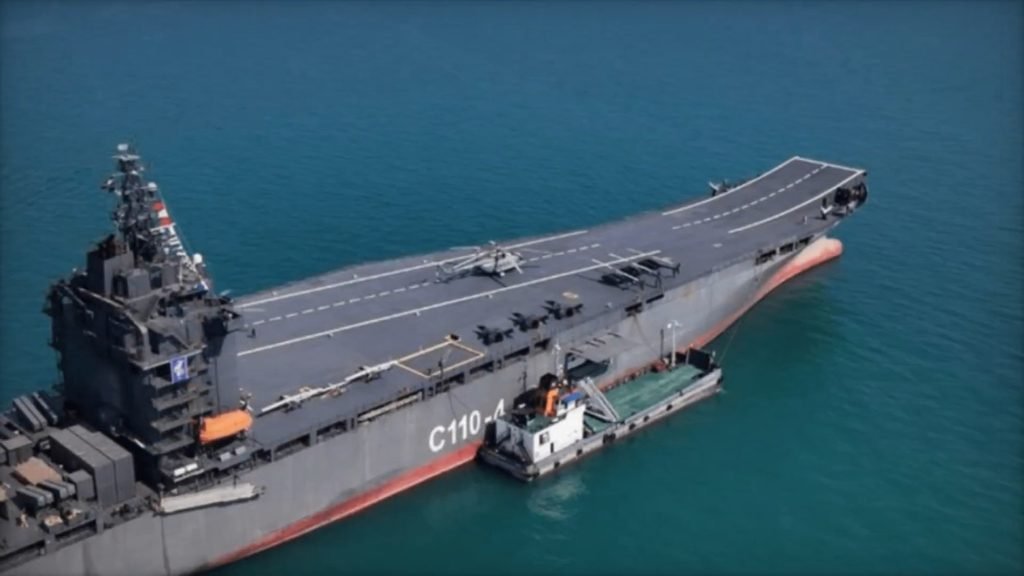
Yet, a closer inspection revealed glaring architectural flaws:
- Commercial Standards: Built to commercial survivability standards, it lacked the compartmentalized armor and damage control systems of purpose-built military vessels.
- Weight Constraints: The flight deck could not support the landing forces of manned fixed-wing jets.
- Logistical Bottlenecks: It featured no dedicated hangar bays for helicopters, and its single elevator was so small it could only reliably move miniature drones.
The “Drone Carrier” Dilemma
The inclusion of arresting gear implied Iran intended to recover reconnaissance or reusable strike drones. However, the payload capacity of drones small enough to use this deck is negligible.
For a military that has perfected the use of cheap, ground-launched one-way attack munitions like the Shahed-136, a massive, slow-moving drone carrier is tactically redundant. Ground and underground launchers are highly survivable, harder to track, and require no landing strip. Concentrating drone assets onto an undefended, easily tracked commercial hull made the Shahid Bagheri a massive floating liability.
Short Life and Sudden Demise
The Shahid Bagheri‘s operational history was remarkably brief. Following sea trials off Qeshm Island in late 2024, it spent most of 2025 drifting idly near Bandar Abbas. Its first and only real “deployment” in November 2025 took it a mere 40 kilometers to the edge of the Strait of Hormuz before scurrying back to port two days later.
When hostilities officially broke out, the ship’s vulnerability was immediately exposed. Just three days into the war, U.S. forces struck the vessel on March 2.
Despite rampant online rumors that the ship had been sunk, satellite imagery from March through April confirmed it was still afloat—but completely disabled.
| Strike Location | Target Consequence |
| Center of Flight Deck | Blew a massive crater in the runway, rendering drone/helicopter launch and recovery operations impossible. |
| Rear Superstructure (Port Side) | Destroyed at least half of the ship’s anti-ship missile launchers and heavily damaged the remaining units. |
The U.S. didn’t sink the Bagheri simply because they didn’t need to. In a target-rich environment, prioritizing munitions is critical. The ship was neutralized, dead in the water, and leaking oil. It drifted—or was towed—into the shallow, silt-heavy waters of the Clarence Strait, where the water depth drops to just 3 to 4 meters. It is highly probable that the hull is now resting on the seabed.
The Illusion of Blue-Water Power
Will Iran attempt to salvage and rebuild the Shahid Bagheri? It is highly unlikely.
The conflict proved what naval analysts had warned for years: operating a pseudo-carrier is pointless if you cannot establish an air defense umbrella to protect it. The rapid neutralization of the Bagheri, alongside other large Iranian surface combatants, literally blew Iran’s blue-water propaganda out of the water.
Ultimately, Iran does not need aircraft carriers to pose a severe threat. Throughout the conflict, their ability to launch continuous waves of ballistic missiles and attack drones from hardened, deeply buried underground bunkers proved far more resilient than any surface ship they could muster. Combined with naval mines and swarms of fast-attack craft operating in the littorals, Iran’s true strength lies in fighting an asymmetric war of attrition—a reality that no flat-decked commercial ship can change.
STRATEGIC VERDICT: The Shahid Bagheri experiment underscores the danger of prioritizing prestige over survivability. By attempting to mimic the visual footprint of a superpower navy, the IRGC created a high-value, defenseless target that was eliminated within 72 hours of open conflict. Moving forward, Iran is expected to abandon vanity surface projects and double down on their proven asymmetric doctrine: burying long-range strike capabilities deep underground and leveraging coastal geography to deny maritime access.
Italy Secretly Arms Ukraine With SAMP/T NG Air DefenseItaly Secretly Arms Ukraine With SAMP/T NG Air Defense