Frontline Defense Journal | Objective OSINT & Military Analysis
  • Home
  • Latest Intellegince
  • USA & Americas
  • Europe
  • Middle East
  • Asia & Pacific
  • About Us
    • Who We Are
    • Terms Of Use
    • Privacy Policy
No Result
View All Result
  • Home
  • Latest Intellegince
  • USA & Americas
  • Europe
  • Middle East
  • Asia & Pacific
  • About Us
    • Who We Are
    • Terms Of Use
    • Privacy Policy
No Result
View All Result
Frontline Defense Journal | Objective OSINT & Military Analysis
No Result
View All Result
Home News
Trending

US Targets Iran’s Pickaxe Mountain With GBU-57 Bunker Buster

The United States has designated Iran’s subterranean "Pickaxe Mountain" (Kuh-e Kolang Gaz La) near Natanz as a primary kinetic target amidst escalating maritime hostilities in the Strait of Hormuz. Buried over 100 meters beneath a 1,600-meter peak, the facility is engineered to withstand conventional aerial bombardment. The Pentagon is signaling the potential deployment of the 13,600-kilogram GBU-57 Massive Ordnance Penetrator (MOP) to neutralize the site before centrifuge assembly becomes fully operational.

greenlightoff98@gmail.com by greenlightoff98@gmail.com
August 26, 2026
in News, Uncategorized
0
Satellite imagery showing hardened tunnel entrances at Iran's Pickaxe Mountain nuclear facility near Natanz.

Satellite analysis reveals multiple hardened tunnel entrances at the Pickaxe Mountain site, sprawling across 2.7 square kilometers.

0
SHARES
50
VIEWS
Share on Facebook
Share on Twitter

KEY TAKEAWAYS BOX

  • Target Depth: Pickaxe Mountain is buried at least 100 meters (328 feet) underground, making it Iran’s deepest nuclear-related facility to date.

  • Primary Weapon: The GBU-57A/B MOP weighs 13,600 kg (30,000 lbs) and delivers a 2,423 kg (5,342 lb) AFX-757/PBXN-114 explosive payload.

  • Penetration Deficit: The MOP penetrates a maximum of 61 meters (200 feet) of earth/rock or 18 meters (60 feet) of 5,000 psi concrete—falling short of the facility’s main depth in a single strike.

  • Strategic Catalyst: Iranian proxy attacks and naval mine detonations on merchant shipping in the Strait of Hormuz and Caspian Sea are accelerating U.S. strike timelines.

The Strategic Context: Strait of Hormuz and Pickaxe Mountain

Iran has dramatically increased asymmetric naval operations, heavily mining the Strait of Hormuz and initiating proxy engagements against merchant shipping in the Red and Caspian Seas. This maritime blockade attempts to leverage global oil transit to fracture U.S. economic pressure.

In direct response, the U.S. has placed Pickaxe Mountain (Kuh-e Kolang Gaz La) squarely in its crosshairs. Located just 2 kilometers south of the Natanz nuclear complex, this sprawling 2.7-square-kilometer underground facility was initiated in 2020 following severe sabotage at above-ground Natanz centrifuge sites.
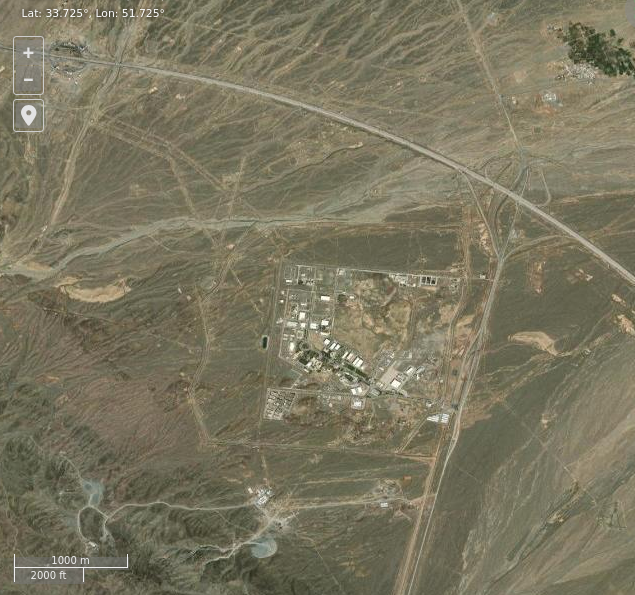
Satellite imagery showing hardened tunnel entrances at Iran's Pickaxe Mountain nuclear facility near Natanz.
Satellite analysis reveals multiple hardened tunnel entrances at the Pickaxe Mountain site, sprawling across 2.7 square kilometers.

Technical Breakdown: The GBU-57 MOP vs. Deep Earth Hardening

To neutralize a facility buried 100 meters deep, conventional munitions are entirely ineffective. The U.S. must deploy the GBU-57 Massive Ordnance Penetrator (MOP), delivered exclusively by B-2 Spirit or B-21 Raider stealth bombers.

The MOP utilizes a specialized steel alloy casing and an integrated GPS/INS guidance package to drill through earth and rock. The weapon relies on extreme ground-shock coupling mechanics before the LPSF (Large Penetrator Smart Fuze) detonates the warhead at the optimal subterranean depth. However, the MOP’s maximum known penetration is 61 meters (200 feet) through earth, leaving a critical 40-meter deficit to the primary centrifuge halls.

Operational Impact: Ground-Shock Coupling and Repeat Strike Tactics

Because a single MOP cannot reach the subterranean centrifuge halls, U.S. operational planners must rely on “drilling” tactics. This requires dropping multiple MOPs with a Circular Error Probable (CEP) of just a few meters into the exact same crater to compound the penetration depth and maximize the kinetic shock effects on the deep tunnel structures.

Alternatively, planners may target the facility’s vulnerable surface infrastructure. By collapsing the two pairs of above-ground tunnel portals, severing external power supply lines, and collapsing ventilation shafts using smaller 907-kilogram (2,000 lb) bunker busters, the U.S. can entomb the facility.

Geopolitical Outlook: Escalation Matrix

While satellite intelligence indicates Pickaxe Mountain is not yet actively enriching uranium, the massive capital expenditure proves Iran’s intent to secure an indestructible nuclear supply chain.

A U.S. kinetic strike sends an unambiguous message: geographical and geological hardening cannot guarantee the survival of Iranian nuclear assets. The escalation matrix now hinges on whether Iran maintains its maritime blockade or capitulates to preserve its subterranean investments.

Metric Pickaxe Mountain (Kuh-e Kolang Gaz La) GBU-57A/B Massive Ordnance Penetrator
Primary Composition Deep subterranean rock, reinforced concrete Specialized high-strength steel alloy casing
Depth / Penetration >100 meters (328 ft) below surface Max 61 meters (200 ft) (earth/rock)
Concrete Resistance Unknown, potentially >30,000 psi domestic concrete Penetrates 18 meters (60 ft) of 5,000 psi concrete
Total Area / Weight 2.7 square kilometers (surface footprint) 13,600 kg (30,000 lbs)
Tactical Profile Vulnerable egress portals, power grid dependence Requires repeat precision strikes; B-2/B-21 dependency

Final Assessment: Pickaxe Mountain represents a structural vulnerability paradox. While its 100-meter depth theoretically protects the primary enrichment halls from a single GBU-57 MOP strike, its reliance on surface-level infrastructure creates critical single points of failure. The U.S. does not need to physically breach the subterranean centrifuge halls to achieve strategic victory; collapsing the egress portals and destroying the ventilation systems will neutralize it as an operational asset, effectively burying it alive.


Tags: air forcegbu57middle eastus iran war
Previous Post

Why Ukraine is Building the World’s Most Complex Air Force in 2026

greenlightoff98@gmail.com

greenlightoff98@gmail.com

Leave a Reply Cancel reply

Your email address will not be published. Required fields are marked *

Stay Connected test

  • 24k Followers
  • 99 Subscribers
  • Trending
  • Comments
  • Latest
Satellite imagery showing hardened tunnel entrances at Iran's Pickaxe Mountain nuclear facility near Natanz.

US Targets Iran’s Pickaxe Mountain With GBU-57 Bunker Buster

August 26, 2026
Why Ukraine is Building the World’s Most Complex Air Force in 2026

Why Ukraine is Building the World’s Most Complex Air Force in 2026

August 26, 2026

Shooting More than 40 Years of New York’s Halloween Parade

July 19, 2026

Game of Thrones spending just as long making fewer episodes

May 25, 2026
Why Ukraine is Building the World’s Most Complex Air Force in 2026

Why Ukraine is Building the World’s Most Complex Air Force in 2026

0

The Legend of Zelda: Breath of the Wild gameplay on the Nintendo Switch

0

Shadow Tactics: Blades of the Shogun Review

0

macOS Sierra review: Mac users get a modest update this year

0
Satellite imagery showing hardened tunnel entrances at Iran's Pickaxe Mountain nuclear facility near Natanz.

US Targets Iran’s Pickaxe Mountain With GBU-57 Bunker Buster

August 26, 2026
Why Ukraine is Building the World’s Most Complex Air Force in 2026

Why Ukraine is Building the World’s Most Complex Air Force in 2026

August 26, 2026

The Legend of Zelda: Breath of the Wild gameplay on the Nintendo Switch

July 26, 2026

Shadow Tactics: Blades of the Shogun Review

July 25, 2026

Recent News

Satellite imagery showing hardened tunnel entrances at Iran's Pickaxe Mountain nuclear facility near Natanz.

US Targets Iran’s Pickaxe Mountain With GBU-57 Bunker Buster

August 26, 2026
Why Ukraine is Building the World’s Most Complex Air Force in 2026

Why Ukraine is Building the World’s Most Complex Air Force in 2026

August 26, 2026

The Legend of Zelda: Breath of the Wild gameplay on the Nintendo Switch

July 26, 2026

Shadow Tactics: Blades of the Shogun Review

July 25, 2026

Frontline Defense is an independent, objective analysis platform. The content provided on this website, including but not limited to technical breakdowns, military hardware comparisons, defense budget reports, and open-source intelligence (OSINT) analyses, is strictly for educational, historical, and informational purposes.
Frontline Defense is not affiliated with, endorsed by, or acting on behalf of any government agency, department of defense, armed forces branch, or defense contractor.
All content on this site represents independent research based strictly on unclassified, publicly available data and open-source records at the time of writing. Nothing published on this website should be construed as official military guidance, defense strategy consulting, or government policy.

Follow Us

Browse by Category

  • Apps
  • Business
  • Entertainment
  • Fashion
  • Food
  • Gadget
  • Gaming
  • Health
  • Lifestyle
  • Mobile
  • Movie
  • Music
  • News
  • Politics
  • Review
  • Science
  • Sports
  • Startup
  • Tech
  • Travel
  • Uncategorized
  • World
Satellite imagery showing hardened tunnel entrances at Iran's Pickaxe Mountain nuclear facility near Natanz.

US Targets Iran’s Pickaxe Mountain With GBU-57 Bunker Buster

August 26, 2026
Why Ukraine is Building the World’s Most Complex Air Force in 2026

Why Ukraine is Building the World’s Most Complex Air Force in 2026

August 26, 2026

The Legend of Zelda: Breath of the Wild gameplay on the Nintendo Switch

July 26, 2026
  • About Us
  • Privacy Policy
  • Terms Of Use

© 2026 | Fronline Defense Journal. All Rights Reserved

No Result
View All Result
  • Home
  • Latest Intellegince
  • USA & Americas
  • Europe
  • Middle East
  • Asia & Pacific
  • About Us
    • Who We Are
    • Terms Of Use
    • Privacy Policy

© 2026 | Fronline Defense Journal. All Rights Reserved