KEY TAKEAWAYS BOX
Strategic Provocation: Putin’s visit to Iturup Island directly challenges Japan’s sovereignty claims over the Northern Territories, deliberately escalating Pacific tensions.
Sino-Russian Energy Dependency: Russia’s reliance on China to purchase approximately 1.25 million barrels of seaborne crude oil daily forces Moscow to align its Pacific strategy with Beijing’s interests.
Japanese Defense Overhaul: Tokyo’s 2026 Defense White Paper accelerates the SHIELD coastal defense program, allocating $1.75 billion for unmanned multi-domain architectures.
Lethal Aid Pivot: Japan’s recent easing of export rules opens back-door channels for transferring lethal weaponry—such as Patriot interceptors—to Ukraine, countering Russian aggression symmetrically.
STRATEGIC CONTEXT: REIGNITING A DORMANT FRONTIER
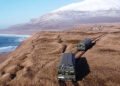
The Kuril Island chain functions as a 1,200-kilometer natural barrier between the Pacific Ocean and the Sea of Okhotsk, serving as a heavily fortified bastion for Russia’s Pacific Fleet and its second-strike nuclear deterrent. The southernmost islands, situated just 4 kilometers off the coast of Hokkaido, were seized by Soviet forces at the end of World War II. Japan has consistently disputed this occupation, referring to the islands as the Northern Territories.
Putin’s August 13 visit was met with swift condemnation. Japanese Prime Minister Sanae Takaichi officially labeled the incursion “absolutely unacceptable,” while Tokyo summoned the Russian ambassador to deliver a formal diplomatic rebuke. Moscow immediately retaliated, with Foreign Minister Sergey Lavrov summoning Japan’s envoy and asserting that Russia’s jurisdiction over the islands is absolute.

GEOPOLITICAL OUTLOOK: BEIJING’S PACIFIC LEVERAGE
While the immediate friction is between Moscow and Tokyo, the strategic beneficiary of this standoff is China. Driven by the economic attrition of the Ukraine conflict, Russia has become increasingly dependent on Chinese energy markets. The stalled Power of Siberia 2 pipeline negotiations demonstrate Beijing’s leverage; China is systematically forcing Russian concessions before committing to joint infrastructure.
For Beijing, a Russia-controlled Kuril chain acts as a vital Pacific release valve. It guarantees unfettered maritime access and prevents potential naval blockades from choking Chinese shipping routes. By antagonizing Japan and entrenching its military presence in the Kurils, Putin proves Russia’s utility to its primary financial benefactor, ensuring the continued flow of oil revenue required to sustain operations in Ukraine.
TECHNICAL & PLATFORM BREAKDOWN: JAPAN’S MILITARY AWAKENING
Japan is no longer maintaining a passive defense posture. Recognizing the rapid evolution of drone warfare in Ukraine, the Japanese Ministry of Defense released its 2026 Dfense White Paper, identifying Russia as an acute threat alongside China and North Korea.
To counter potential incursions, Japan is heavily investing in SHIELD (Synchronized, Hybrid, Integrated and Enhanced Littoral Defense). This multi-domain architecture networks low-cost aerial, surface, and underwater drones to detect and neutralize hostile approaches. Tokyo has surged its budget for unmanned capabilities to ¥277 billion ($1.75 billion), integrating civilian AI innovation with military applications. Furthermore, Japan’s recent relaxation of arms export rules allows for the transfer of lethal weapons to 17 allied nations under strict vetting, establishing a framework that could eventually supply Ukraine with Japanese-manufactured munitions and Patriot missile interceptors.
| Strategic Metric | Data Point | Geopolitical Implication |
| Proximity to Japan | 4.0 km (Hokkaido) | Enables line-of-sight electronic warfare and rapid amphibious threats. |
| Japan Unmanned Budget | ¥277B ($1.75B) | Massive scale-up of the SHIELD coastal drone defense network. |
| Chinese Oil Procurement | 1.25M BPD | Sustains the Russian war economy, granting Beijing immense leverage. |
| Japan Aid to Ukraine | $20B+ pledged | Financial attrition against Russia; potential pivot to lethal aid. |
TACTICAL / STRATEGIC VERDICT
Putin’s decision to antagonize Japan is a profound strategic miscalculation born of economic desperation. By attempting to project strength in the Pacific to appease Chinese geopolitical interests, Moscow has accelerated the awakening of the Japanese military-industrial complex. Tokyo is now rapidly integrating advanced autonomous defense networks and rewriting its arms export frameworks. Ultimately, the Kremlin’s Kuril provocation practically guarantees deeper, and potentially lethal, Japanese integration into the defense of Ukraine, opening a second strategic front that an overextended Russian military cannot afford to manage.